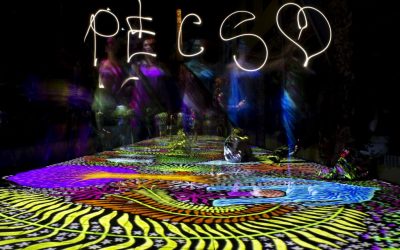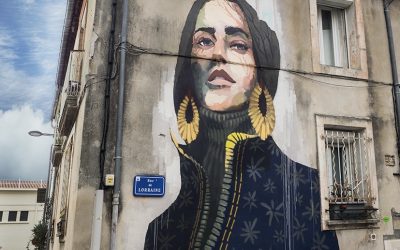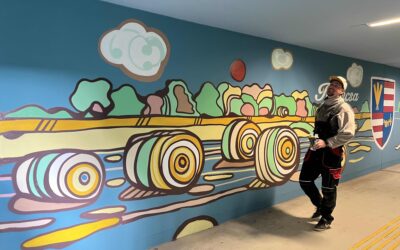

For a long time, the underpass at the Iváncsa train station was just another one of those familiar, functional, yet impersonal spaces. A place people pass through but don’t linger in. Today, however, it offers a completely different experience: colors, shapes, and stories accompany travelers along the way. The decoration is not only a visual renewal but also an imprint of a community-oriented vision—the identities of three towns converge here with László Varga’s unique perspective.
Builder & Author
Csabi Gyuris
From the Author
Adam Illes – Reflections
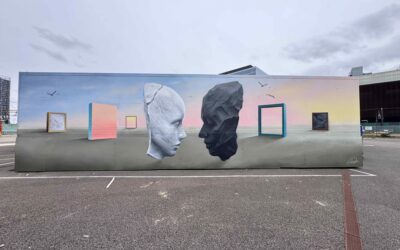
His work titled *Reflections*, installed on the wall of Stratford Junction, explores a theme that is both personal and universal: connection. Not an encounter in the superficial sense, but that rare and elusive moment when two people truly see one another.
Attraction Launches Global Brand; SAHAR Makes Its Debut in Budapest
For more than two decades, this company—which blends shadow play and dance—has been captivating audiences with its diverse productions. Now they are preparing a new project that is even more unconventional than their previous ones: the team is responsible for creating an international experience brand called SAHAR, which will launch in Budapest and is expected to be followed by dynamic international expansion.
When Paint Turns to Glass – Glass Angel
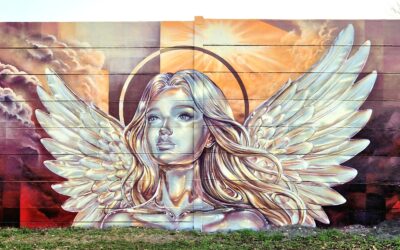
Street art is often about quick gestures and raw energy, but there are works that speak more of patience, precision, and a carefully constructed visual experience. CSM’s work titled “Glass Angel” is the final piece in a four-part mural series that not only posed a serious technical challenge but also holds personal significance for the artist. The transparency of the glass symbolizes fragility, the angel represents beauty and love, while the dark and light tones in the background symbolize the duality of the world.
Interview with street artist Wanda Hutira
Wanda Hutira is one of those artists for whom the city is not merely a backdrop, but an active partner in dialogue. Using murals, illustrations, and experimental visual techniques, she creates images that respond both to their surroundings and to the stories of the people who live in them. Her works are often based on small observations of everyday life and social and psychological issues, while her unique technical experimentation—from "impressionistic" distortions created with a paint roller to typographical references—creates a unique visual language. With more than a hundred murals behind her, Wanda Hutira now not only paints pictures on walls, but also initiates quiet conversations between the city and its people.
Colors Of Women – Where contemporary art and the night meet
On the eve of Women’s Day, the cream of the crop of contemporary Hungarian art took up residence within the walls of Club Heaven Budapest. On this evening, elegance, a sparkling night, and visual ecstasy came together in a single, once-in-a-lifetime EXHIBITION PARTY. More than an exhibition. More than a party. An exceptional journey into the deepest hues of the female soul.
Fédra Csicsely – Health is not a matter of extremes, but conscious simplicity
For Fédra Csicsely, health is not a trend, but a mission. Her family background, personal encounter with sports, and commitment to mental health have shaped her professional path, where dietetics, training, and health promotion form an interdependent system. In her work, she emphasizes simplicity, gradualness, and sustainability—because she believes that lifestyle change is not about extremes, but about conscious, small steps.
Interview with graffiti artist Refleks
Refleks first picked up a spray can in 2009, and since then he has been consistently developing the style that many people now recognize immediately. In this interview, he talks about the thought process behind his name, his obsession with thin, precise lines, his open ambition for fame, and his view of the current state of the domestic and international graffiti subculture. Travels, iconic locations, strong opinions, and clear messages—Refleks doesn't explain, he reflects.
Interview with Angel Twosix
For Angel Twosix, graffiti was never a question, but rather a state of being. Not an explanation, not a message, not a statement—but a commitment. To letters, to creation, to that inner urge that was there long before it had a name. In this interview, he does not build a legend, define graffiti, or try to explain why it is important. He simply explains what it means to him: a source of joy, community, constant renewal – and a game that sometimes burns you out, yet you return to it again and again.