

Bitcoin didn’t appear out of nowhere in 2008, but was the result of a long intellectual journey. And perhaps this is where the figure of Satoshi becomes more human: not a mystical genius, but someone who recognized what others had previously seen only in isolation. His genius may not have been a new invention, but rather a realization. Satoshi did not build the financial system of the future alone; rather, he recognized how the work of others fit together.
The Bitcoin story is often told as a modern-day myth.
In the fall of 2008, an unknown individual or group published a nine-page document. A few months later, they launched a new financial system. Then they disappeared.
The story's main character has only one name:
Satoshi Nakamoto.
Most people therefore tend to think that Satoshi invented something completely new: some kind of revolutionary mathematical formula, a previously unknown cryptographic technique—a breakthrough that radically changed the world.
The reality, however, is much more interesting than that.
Perhaps Satoshi's true genius did not lie in creating new building blocks.
Rather, it was in the fact that he realized the building blocks already existed.
And for the first time, he saw how they could be pieced together into a functioning system.
The misconception: Satoshi invented everything
If we look back at the birth of Bitcoin, it’s easy to get the impression that something completely new appeared in the world in 2008.
In fact, however, most of the technologies behind Bitcoin had already existed for years, or even decades, prior to that.
Public-key cryptography was developed as early as the 1970s.
Digital signatures were considered a well-established technology.
As early as 1980, Ralph Merkle introduced the data structure that would later become known as the Merkle tree.
Stuart Haber and W. Scott Stornetta developed the foundations of cryptographic timestamping in the early 1990s.
Adam Back created the Hashcash system.
Wei Dai developed the concept of b-money.
Nick Szabó, meanwhile, devised the Bit Gold plan.
When Bitcoin was created, most of the pieces were already in place.
The question wasn't how to discover new elements.
The question was:
how can these be combined so that they actually work?
The Long-Held Dream of Digital Money
Today, it seems natural to talk about digital money.
In the early days of the Internet, however, this was by no means a given.
The problem seemed simple.
If we can send emails, copy documents, and share files, why can't we send money too?
The answer lay in one of the fundamental characteristics of the digital world.
All digital information can be copied.
An image can be copied.
A document can be copied.
A song can be copied.
However, if money can also be copied without limit, then it ceases to be money.
The biggest obstacle to the creation of digital money was the problem of double-spending.
How can it be proven that the same digital coin wasn't spent twice?
Most previous solutions ultimately led back to a central actor.
Someone always had to check the general ledger.
Someone always had to decide which transaction was valid.
Before Bitcoin, no one was able to provide a working solution to this problem.
The pieces of the puzzle already existed
The history of Bitcoin is perhaps best compared to a jigsaw puzzle.
One of the researchers created an important piece.
One after another.
Someone else, a third one.
They have all solved important problems.
But no one saw the whole picture at once.
Ralph Merkle
He created the Merkle tree.
This made it possible to efficiently monitor a massive amount of data.
Stuart Haber and W. Scott Stornetta
They demonstrated how to cryptographically time-stamp documents.
One of the most important fundamental concepts of blockchain stems from this.
Adam Back
He created the Hashcash system.
And so the concept of Proof of Work was born.
Wei Dai
He presented the idea of b-money.
A vision of a decentralized digital monetary system.
Nick Szabó
He devised the Bit Gold plan.
Perhaps Bitcoin's closest intellectual predecessor.
The Relationship Between Bitcoin and Hungary
👇
Hal Finney
He developed the Reusable Proof of Work system and later became the first person to receive Bitcoin from Satoshi.
They were all working on the same problem.
Just not in the same room.
And not at the same time.
Genius comes from many angles
I once read a quote about Ralph Merkle:
“Genius comes from many angles.”
There is perhaps no phrase that better sums up the history of Bitcoin.
Merkle didn't set out to create Bitcoin.
Adam Back didn't set out to create Bitcoin.
Haber and Stornetta did not set out to create Bitcoin.
Nick Szabó didn't set out to create Bitcoin either.
Each of them tried to solve a specific problem.
In the end, however, their work became part of the same story.
This is one of the finest examples of the advancement of science and technology.
Major breakthroughs rarely happen in an instant.
They are more often built on the work of many people who are independent of one another.
What was Satoshi's true innovation?
And this brings us to the most important part of the story.
What was it that Satoshi added?
He did not invent a new hash function.
He did not invent a new encryption method.
He did not prove a new mathematical theorem.
But he did something else.
He recognized the connection.
He realized that:
- digital signatures can establish ownership,
- Proof of Work can ensure consensus,
- time stamping can ensure chronological order,
- a peer-to-peer network can replace the central entity,
- and blockchain can replace the traditional general ledger.
None of them, taken individually, solved the problem of digital money.
Together, though, yes.
That was the realization.
That was the missing link.
What would have happened if Satoshi had never shown up?
This is one of the most interesting questions in the history of Bitcoin.
It's possible that the world would have ended up with a similar system sooner or later anyway.
Maybe in 2012.
Maybe in 2015.
Maybe later.
We'll never know.
What we do know, however, is that in 2008, Satoshi was the one who first showed how the pieces fit together.
History is full of people who came up with great ideas.
Fewer people realize how these ideas can be woven together into a coherent whole.
More Than Just Technology
The history of Bitcoin is therefore not merely a technological story.
It's a human story, too.
The History of Researchers.
The History of Thinkers.
It belongs to people who have often worked on the same problem independently of one another.
If Satoshi's true genius had to be summed up in a single sentence, it might go something like this:
“He didn’t invent the pieces of the puzzle. He was the first to see the whole picture.”
Summary
Bitcoin is not a single invention.
It is not the work of a single person.
It is not the result of a single moment of inspiration from a single genius.
The intersection of decades of research, debate, failure, and innovation.
Digital signatures, cryptographic timestamping, Merkle trees, Proof of Work, and decentralized networks all contributed to its creation.
Satoshi Nakamoto's genius may not have lain in creating new elements.
Rather, it was in the fact that he realized: the solution is already right in front of us.
You just have to put it together.
And when all the pieces finally fell into place, Bitcoin was born.
Hungarian Heritage
However, the connection between Bitcoin and Hungary does not end with the story of Nick Szabó.
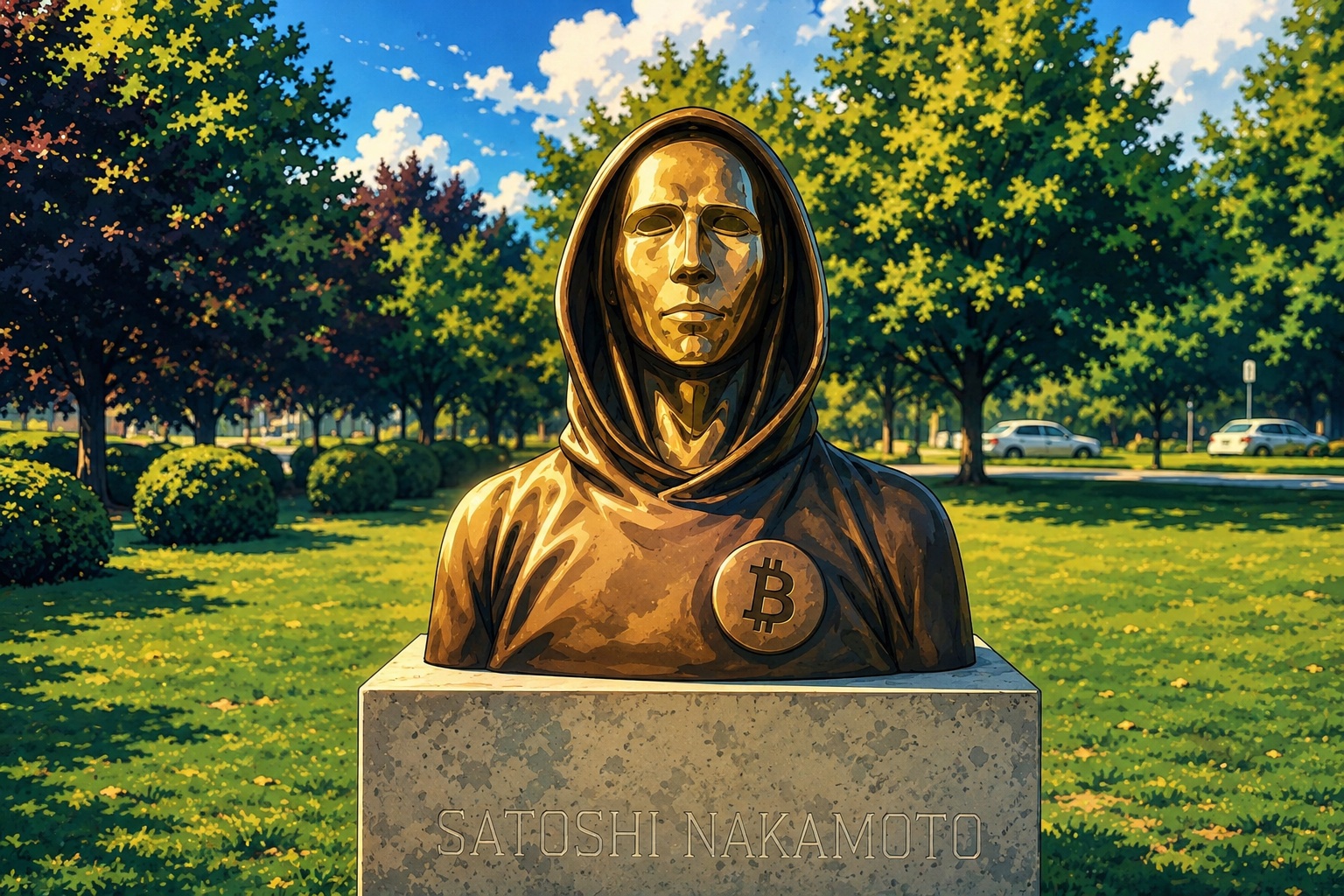
In September 2021, Budapest took its place in Bitcoin history once again: it was here that the world’s first statue of Satoshi Nakamoto was unveiled. The bronze sculpture was installed in Budapest’s Graphisoft Park and has since become one of the Bitcoin community’s symbolic landmarks. The sculptors deliberately chose not to depict a specific person, as we still do not know who—or who all—is hiding behind the name Satoshi Nakamoto. The statue’s face was therefore given a mirror-like, shiny surface so that everyone can see their own face reflected in it. The message is simple:
“We are all Satoshi.” – “We are all Satoshi.”
The unveiling of the world’s first Satoshi statue in Budapest holds special symbolic significance. While one of Bitcoin’s most important intellectual precursors, Nick Szabó, has Hungarian roots, the first public artwork commemorating Bitcoin’s creator was also created in Hungary. This does not, of course, mean that Bitcoin is a Hungarian invention, but it does clearly show that the Hungarian connection is more than just a footnote in the story.
Perhaps that is why it is no exaggeration to say that when we tell the story of Bitcoin, the name “Hungary” pops up in the background on several occasions.