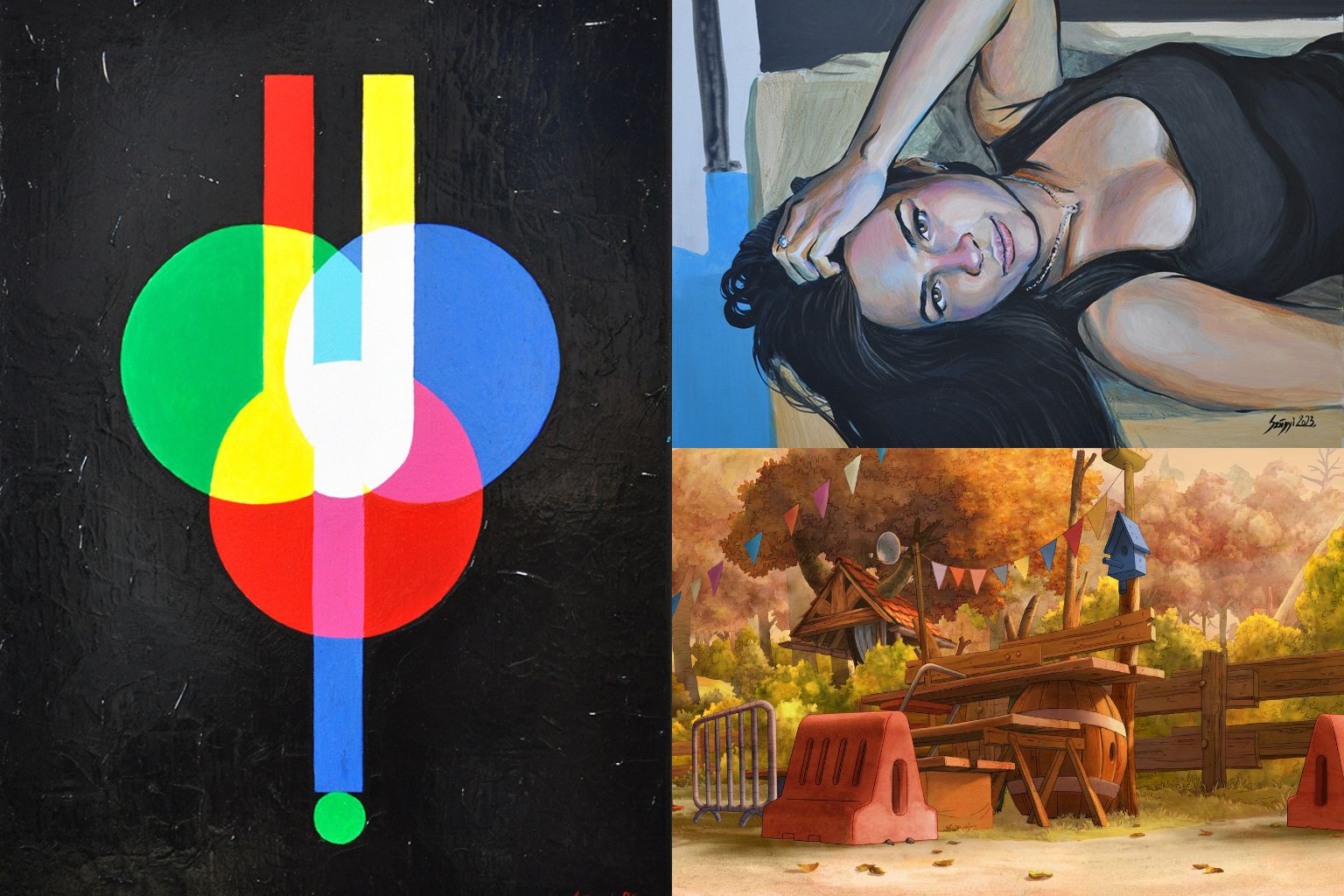
Gábor Szügyi's career is a rare example of how classical artistic foundations, applied visual professions, and autonomous creation are not alternatives to each other, but rather layers that reinforce each other. From art school in Pécs to the University of Fine Arts, through Hungarian animated films and international productions, all the way to digital sculpture, his career path is defined not by a single style or medium, but by continuous learning, adaptation, and inner curiosity.
In his works, drawing, painting, film, video games, and 3D technology are not separate worlds, but tools of a common visual thinking. In addition to technical proficiency, a strong intellectual and philosophical interest is also present throughout: art history, literature, astronomy, science, and metaphysics interweave his creations. Whether it is applied work or autonomous art, for him, the image is not an end in itself, but a space that carries meaning.
This conversation not only traces the professional career of a multifaceted artist, but also provides insight into the mindset behind the "Swiss Army knife" creative model: how to be present in the market and in one's inner world at the same time, to do disciplined professional work while preserving the joy of creation—the inner fire that has kept him going for thirty years.
I. Career start, professional foundations
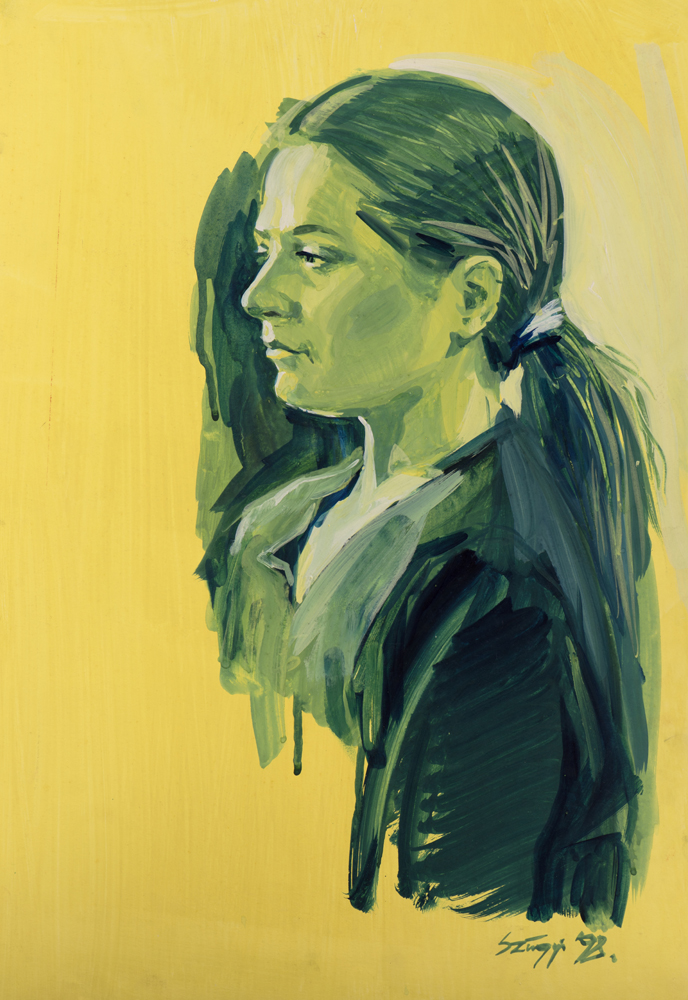
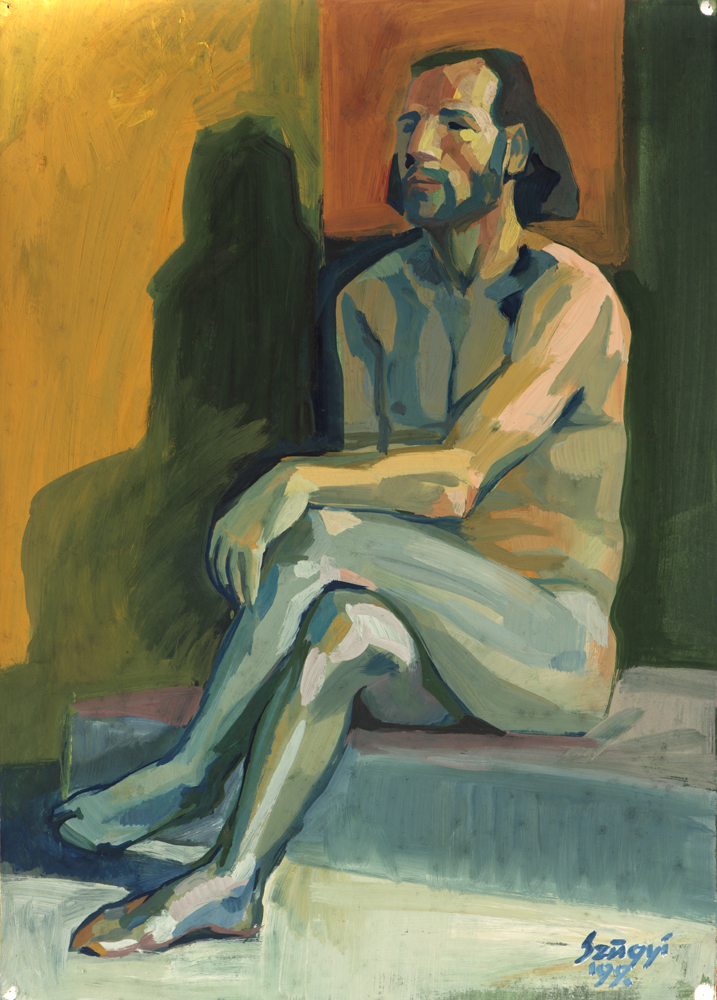
I began to seriously pursue drawing at the Pécs Secondary School of Art. I had good teachers who helped me develop my skills. I spent four wonderful years there. Just like the ceramists, we goldsmiths also made models. We sculpted with clay and made heads. We drew, painted, studied art history, descriptive geometry, and goldsmithing. In drawing class, we learned traditional artistic basics, from cubes to nudes. Cubism for perspective and proportions, shading, drapery, solids, portraits, nudes, anatomy. Painting techniques. Watercolor, tempera. Pencil and charcoal drawing.
After that, I spent two years at the Decorator Training School, where my art teacher was the esteemed Mr. Károlyi. Then came a year in the army in Szentkirályszabadja, where I drew many portraits of soldiers. We didn't have to go home, we had time. 🙂 I served in the 1990s, during the Balkan War. There were MI-24s, MI-8s, and 17s at the airport. Thank God, my service was peaceful. I also participated in the Göd Creative Camp. It's a great place. 🙂
Shortly after I finished my military service, I was accepted into the Academy of Fine Arts, where I studied graphic design. During the first two years, I had studio classes and learned painting techniques. I painted every day. 🙂 At the same time, I also did illustrations for sci-fi, fantasy, and later historical themes. It was an exciting time.
You have been in the arts for thirty years.
What was the inner driving force that kept you going for so long?
I loved drawing even as a small child. I think everyone loves drawing when they are young. Then some people stop, while others continue because it gives them a sense of achievement and they believe that it is worth choosing this career despite all the difficulties.
And what drives us? Well, drawing is great. The fact that worlds, characters, portraits, nudes, tales, and stories are born from a pencil or brush is magical. When you immerse yourself in an illustration, you are right there. It's an experience that makes it worth doing. The experience of creation, brainstorming, this intellectual adventure and creative excitement is a state that sucks you in and completely captivates your attention. If this brings a sense of achievement and even money, there's not much reason to stop. This inner fire keeps you going.
A career spanning from Pannónia Film Studio to Hollywood productions is a rare life path.
What did the world of film give you that you wouldn't have gotten in other areas of art?
Painting and studio work are solitary pursuits. Filmmaking is teamwork. In film, we work with several people, and our work is interconnected. You have to know how to work so that others can continue working with your work. I also receive pre-drawn backgrounds that are already prepared for my work. We work under each other's hands.
The first film I worked on was Ének a csodaszarvasról (Song of the Miraculous Deer), which was made in Pannónia. I loved that place. I was very lucky to be able to learn from the greats: Marcellt Jankovics, Józseft Gémes, and Zsoltt Richly. It was an amazing experience to see my work on the big screen.
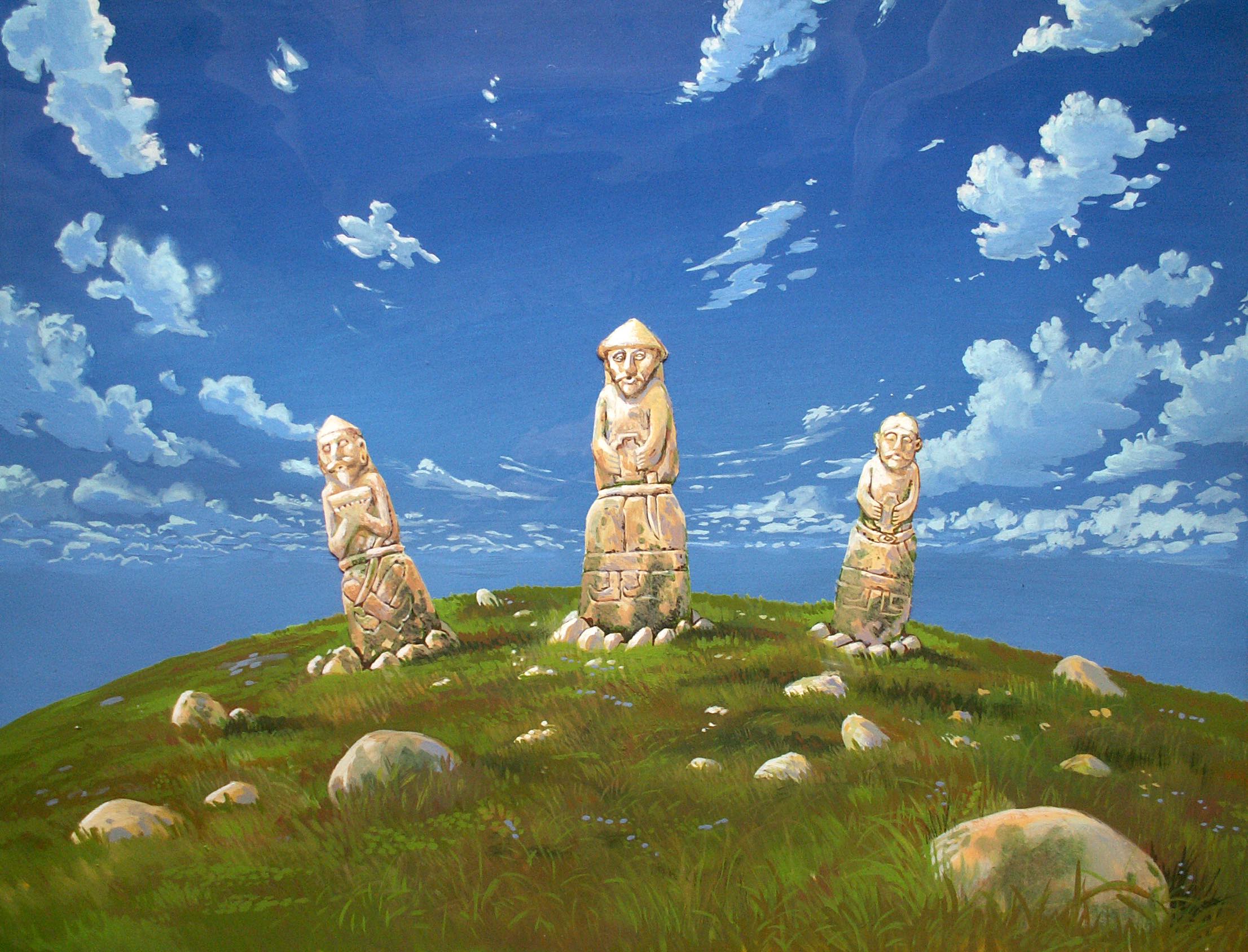
2000. Miraculous Deer – Kun Babies on the Steppe
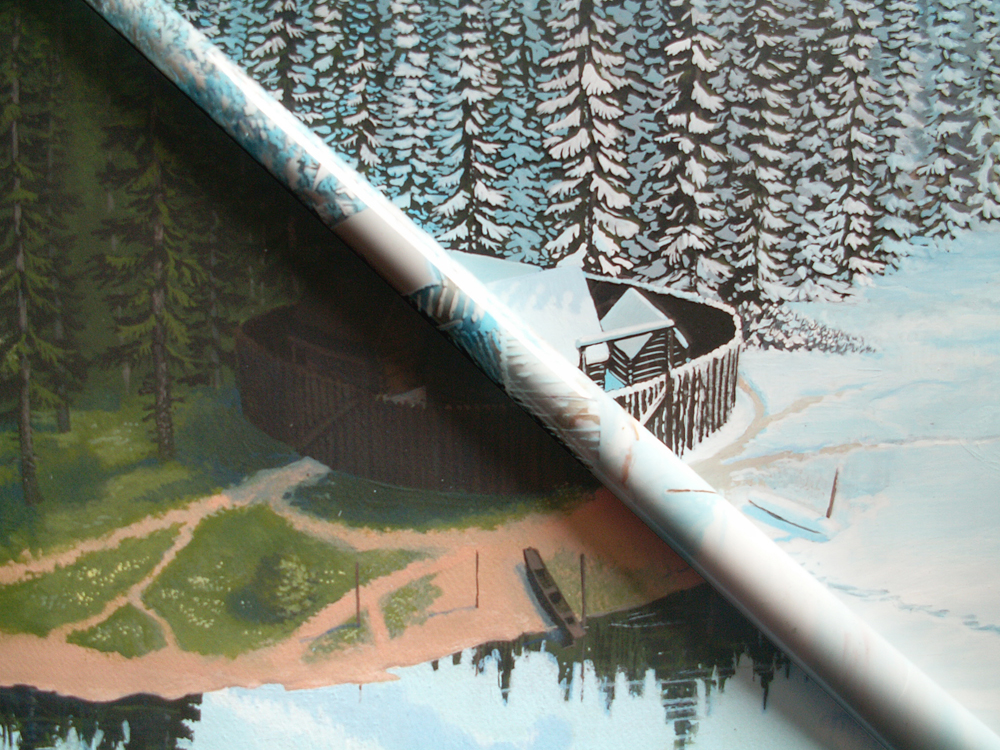
2000. Miraculous Deer Winter-Summer Background
What the animators did was also exciting; I loved the movement rehearsals where Marcell, with great enthusiasm, often used his hands and feet to explain exactly what he wanted to see. I learned new terms. Image composition, sequence, continuity. I mean, there has to be continuity between scenes. There are tons of different styles of animated films. More than the number of types of chocolate that Gombóc Artúr can list, and that's not a small number. 😀
After Csodaszarvas came Mr. Bean. A few streets away, on Raktár Street in Óbuda, was the Varga studio. That's where the film was made. There, for example, we had to create vector backgrounds. I remember one day I was there to deliver the backgrounds when the news broke in the office that two planes had crashed into the WTC. That's how I know which day it was.
After Mr. Bean, I worked on graphic design for a long time, developed my 3D skills, and then came Macskafogó 2. I had to paint watercolor backgrounds for it, and I made a few designs for the new robot dog. 🙂 It was good work. Then I got to work at Cinemon on the French-Belgian-Hungarian animated film The Sun Queen. It had a really cool style.
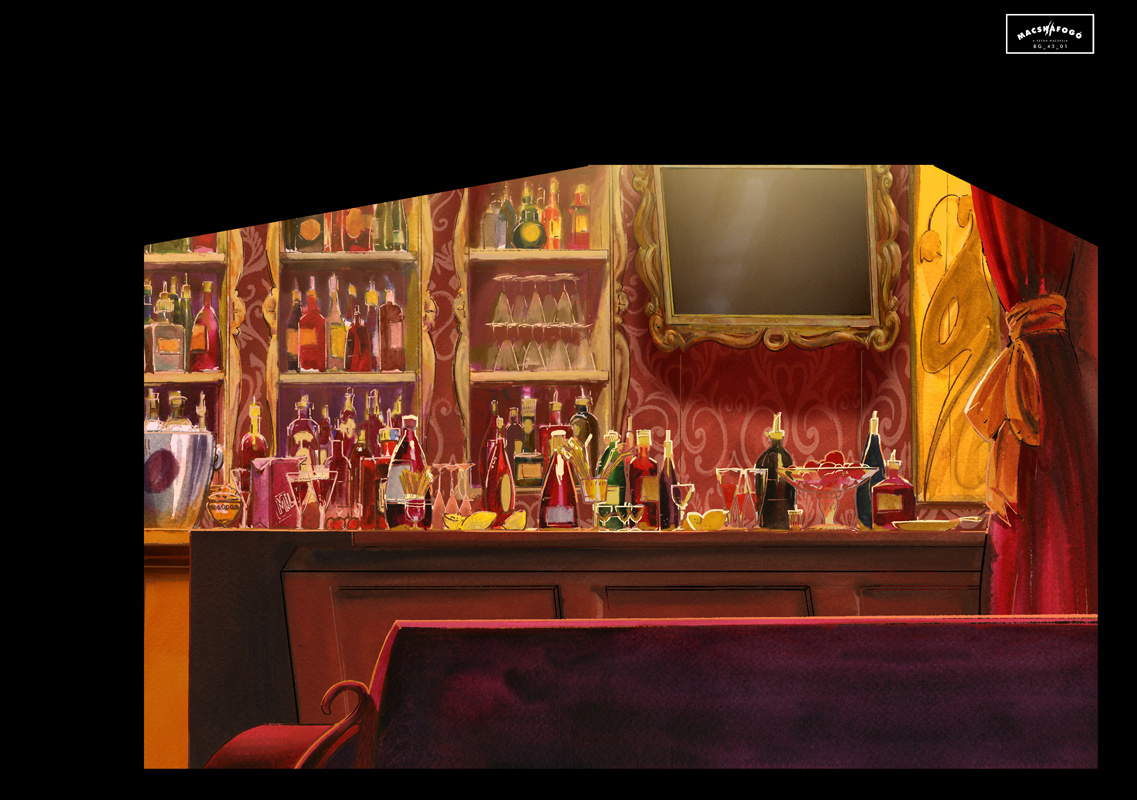
2006. Catcatcher 2 – Gatto's Office
After animated films came matte painting work in Prague. I had some film experience, I illustrated and painted a lot, so the company trusted me and after a month's trial period we did a test and they hired me. There, we didn't draw the backgrounds, but worked with photos until they perfectly matched the filmed material. I got to work on a lot of great films there.
What else did the film give me? Professional development, Grand Tour. Domestic and international productions. And colleagues. 🙂
II. Film, video games, international experience
You have worked as a matte painter and digital background artist on European and Hollywood productions.
What is the biggest difference between domestic and international film thinking?
The domestic and international film lineup is so diverse that it is difficult to highlight any differences; at most, we can only speak in general terms...
Technically, the same crew often shoots both Hungarian and foreign films here in Hungary because the film studios and professionals are good. There have been a few road closures in the city center because they were shooting a movie. A few years ago, I was in the city center; I went to Művészellátó on Bajcsy-Zsilinszky Street when they were filming The Black Widow on a nearby street. 🙂 So technically, there is no difference.
How different is Hungarian cinema in its tone, mood, and themes? Márai comes to mind. When he writes about his life in exile around 1944, he says that American life is comfortable. It is livable. European culture has a certain suffering inherent in it. This gives it depth. We have had our fill of history, we have our Werkmeister harmony. Saul's son. The wind whistles under their feet. I watched it again yesterday. A realistic eastern, lit like a Munkácsy painting. Drama, tragedy. The world is changing, the continuous wilderness and the bandits are disappearing. Of course, we have good comedies and beautiful actresses, but what comes to mind when we think of French films? Lightheartedness. Flirtation, romance. Paris is called the capital of love. What is Budapest the capital of? The meeting point of Eastern and Western culture? The pearl of the Danube?
Or what defines Hungarian cinema? Or Hungarian culture? Béla Hamvas's Five Geniuses of the Land? The coexistence and interaction of many different mentalities? Our characteristic humor, our sometimes melancholic outlook on life, a negative, sad, gloomy tone that perhaps stems from our history? It would be good to explore this. Not to pile it on, but to learn to enjoy life.
The Scandinavians also have dark stories. And beautiful blonde women. 🙂 Just as we have comedies and romantic films. I think that if people want to enjoy themselves, there's nothing wrong with making films that we can watch and enjoy. We weren't like that in the past.
How did Faludy write about the Kurucs?
"They are a wild, boisterous people: they shout, they spit,
sings and jokes until the scaffold;
their eyes are filled with golden light,
The wind lives on the back of their necks.”
Well, we need to get something back from this. Virtue, joy of life.
What did it mean professionally and personally to work with George Lucas or Francis Ford Coppola on a production?
They are creative geniuses, and it was a great experience to work on their films. We didn't have a daily working relationship with them, but when they came to visit the company in Prague, we were lucky enough to meet them. It was an extraordinary occasion. The film we worked on reflected their needs and ideas. We had to do our best to produce high quality work. I learned a lot in Prague. The company placed their trust in me, and I learned the ropes. I often say that it was an intense period. Challenges, difficulties, development. Adventure. Worldliness.
When I first spoke to my lead, he asked me what I expected from the company. I replied that I wanted to develop professionally, improve my English, and get to know the city. Fortunately, all of these came true. The fact that I was able to work on films by two such excellent directors exceeded my expectations. 🙂 It speaks volumes about the quality of the company.
Your graphics appear in both films and video games.
Do you think differently about the "function" of an image when it becomes part of a moving image or interactive medium?
Yes. Fine art is l'art pour l'art. Its advantage is also its disadvantage. You are free to do whatever you want and then try to sell it if you succeed. Since you are not working on commission but following your own ideas, there is either a demand for what you do or there isn't.
The genre used is the order, contract, professional knowledge, and what the person creates is also purchased. Be it illustration, 3D, film background or texture, visual design, or concept sketch. If a person has a portfolio that shows their abilities, there will be trust and cooperation. This is one of the key differences. There is a budget, they look at what it is spent on and who gets the opportunity.
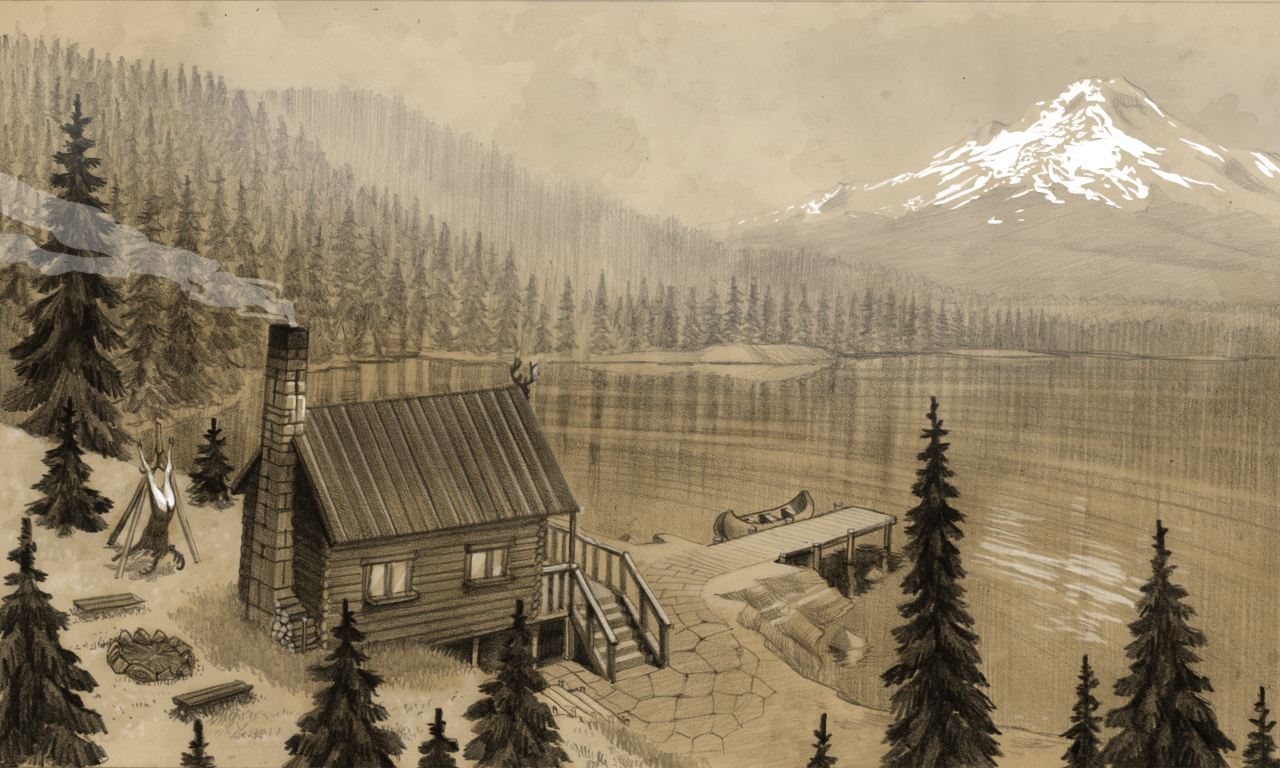
2008. Activision pr Legendary Adventures – 1999. Benton County Oregon

2008. La Reine Soleil
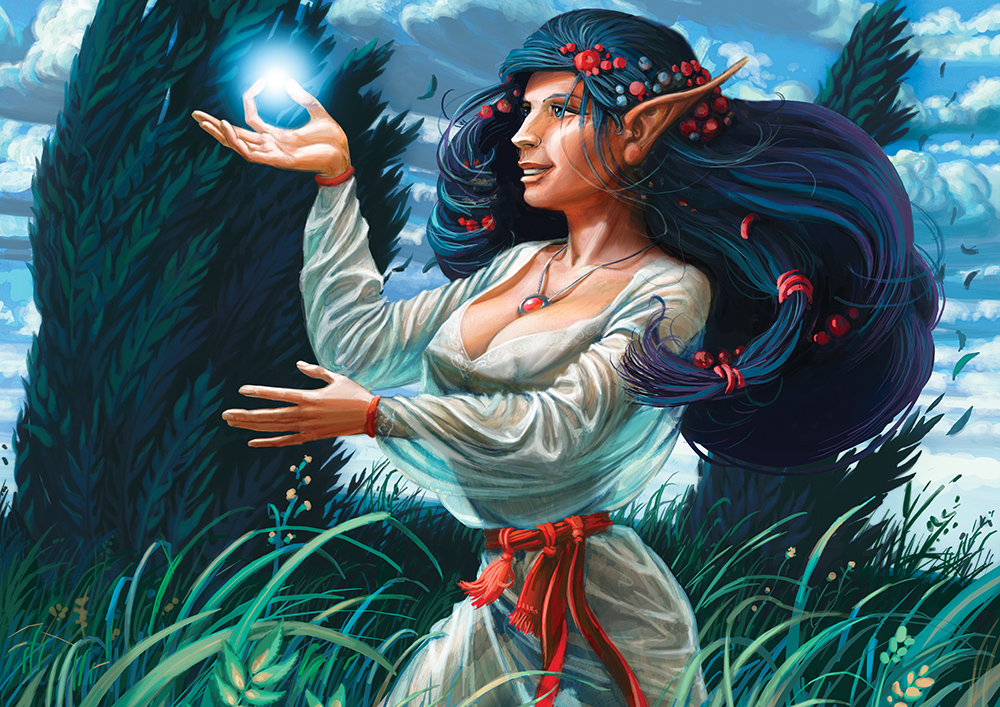
2008. TCG illustration HKK Szilmill, master of magic
Another important factor in motion pictures is time. An hour and a half is 90 minutes = 90 × 60 seconds = 5,400 seconds. One second is 24 frames × 5,400 = 129,600. Animators could tell you a thing or two about what 130,000 frames means. 🙂 You can do a lot with that many frames. And to keep the production together, you have to pay attention to what is asked of you. Teamwork. That's why there are directors and production managers.
If a cartoon has a certain style and requires the work of 5-10 background artists, then those 5-10 people must be able to approach a specific style at a level that does not disrupt the film. Continuity. Consistency. You can't have blue skies in one frame and purple skies in another in the same scene at the same location. This is not self-expression but professional work at an artistic level. You can't paint in a different style.
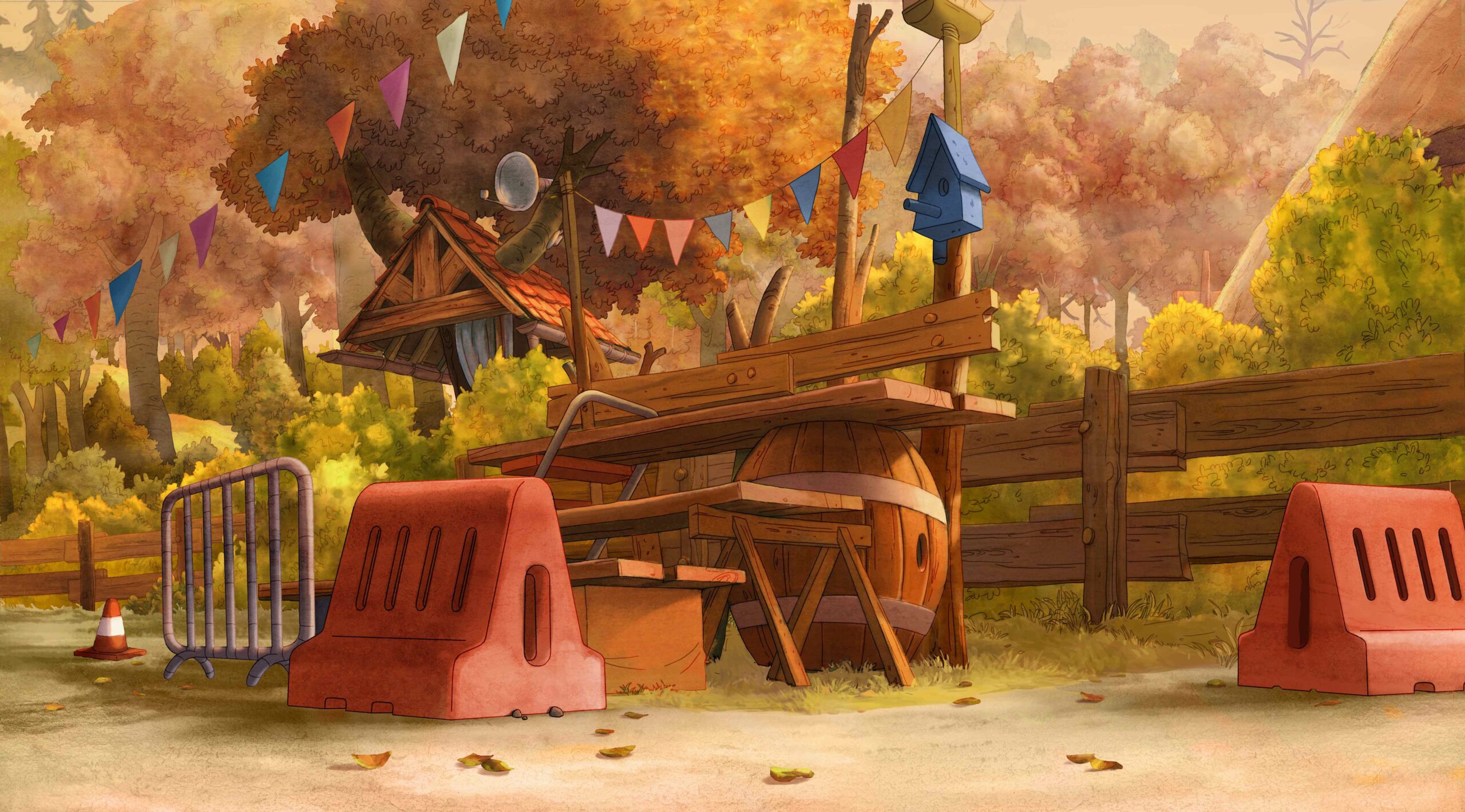
2014. Rabesocke 2
That's why when you're not doing your own thing but working on contract, you have to serve the production with the necessary professional humility. Overall, I'm lucky to have been able to work in many good places. I loved doing it, and that's why people liked working with me, because it showed in my attitude. It's no coincidence that there are repeat clients in my portfolio.
Have you ever had a job that received more attention abroad than at home?
How did this affect your self-image and artistic direction?
When I create my own graphics, paintings, or sculptures, I am searching for my artistic direction. Should it be abstract or figurative? Stylized or photorealistic? What themes should I explore? How should I paint it? What materials and techniques should I use? That's when I brainstorm, think, and express myself. These are my decisions.
How did my self-image develop? When you achieve something successfully, it gives you healthy self-confidence. I learned many professions. I have become versatile. I can say that I am a film professional, a 3D artist, a sculptor, a graphic designer, an illustrator, and a painter. Wherever I work in a particular genre, I have to keep learning in order to develop.
III. The "Swiss Army knife" artist model
As you put it, today an artist must be a "Swiss Army knife."
I think so; it's good to have more than one string to your bow. We live in such a changing world that there's no guarantee that if you get a degree, you'll be able to make a living from it for decades. It's good to have more than one skill. I have a combination of basic skills in art, graphic design, and painting. Art school training is based on a certain amount of modest talent, and from this center, I learn additional professions, shooting in all directions like Robin Hood. 🙂 Well, not in all directions; only those that interest me and are related to this inner creative core.
What skills are essential for long-term success today?
Continuous learning. Professional humility. Diligence. Social intelligence. HR professionals refer to the latter as soft skills. The ability to cooperate. And earning money.
You can do art for art's sake from time to time, but it's good to have both feet firmly on the ground because you have to make a living somehow. Ideally, the two go hand in hand, but let's be honest, how many artists can do that these days? We have to accept that either we support artists through purchasing their work or patronage, or we acknowledge that it is natural for them to do many other things alongside their art.
Making a living has never been easy since art came into existence. L’art pour l’art is a relatively new concept. In the past, art was techné. Craftsmanship. Profession. Masterwork. The ancient Greeks left us artists, but they were not artists in the sense that we use the word today (for its own sake), but rather craftsmen. Potters who made black and red amphorae, sculptors who carved statues of gods and mortals. It was their craft, their profession. Creative professions. They understood something they could sell because they were good at it and because there was a need for it.
Do the many different areas of application—graphics, film, games, digital technologies—enrich or fragment creative identity?
Both are true. 🙂 Some people are lucky enough to learn one profession and thrive in it. Others need to learn more, which makes them more versatile. More resilient.
There are professions that will always be needed. Everyone knows that art is a difficult way to make a living. I think it was in a Woody Allen film that one of the characters said: I traded my uncertain career as a dentist for a secure career as a visual artist. 🙂 I'm like Sergeant Lazy Dick, who is the entire police band all by himself. 😀 But each one is an instrument! In other words, each field is related to visuality, to image creation. Space, form, color, composition. Creation.
Where do you draw the line between applied art and autonomous creation—does this line even exist anymore?
Autonomous art is art for art's sake. Not for money, but for art itself. Applied art is when someone learns a profession and can sell their artistic abilities. From this point of view, the two are different. At the same time, both require artistic skill. The gaming industry and film are both about production, while graphic design is about developing one's own style, so they have something in common. Applied art reflects the graphic designer's individuality beyond the client's needs.
Illustration also serves a purpose, but whoever does it inevitably makes it unique. Unless they use AI. Then it's a dime a dozen. But whoever learns to draw learns about the world as they put their experiences on paper, and that makes it unique. Even when drawing a single stone, they draw what they know about the stone. This knowledge is subjective, and that is what makes every artist, every creator unique.
IV. Fine arts and personal projects
When did you feel that autonomous fine art was not a "side branch" but an equal and even necessary continuation of your career?
When you go to art school as a teenager, you want to be an artist. More specifically, you want to draw because it's fun. But people kindly warn you that it's a difficult career path. Learn a trade because you can't know if you'll be successful. Some people will be, some won't. It's not just a question of talent, but also of financial background and connections.
I have also been a visual artist since my teens. But since I am involved in other things, I exhibit less often. Still, I think about it, it runs in the background, and from time to time I paint my pictures. Plans, sketches, and directions accumulate. When my works are purchased, I will put more energy into my fine art career.
How conscious is the art historical reference in your case, and how intuitive?
You are what you eat. That's what the saying goes, and it's true in a spiritual sense too. We studied art history three times in art school, from prehistoric times to the present day. Once in four years at the Secondary School of Art in Pécs, once in two years at the Decorative Arts School, and finally, in the most detailed way, at university, where we took a rigorous exam at the end of the second year and a state exam at the end of the fifth year. I always loved art history, and I learned it easily because I was interested in it. 🙂 Art is the more beautiful side of the world. People are receptive to beauty.
I know what I am quoting, I know the context. When I use references to art history or philosophy. For example, Kandinsky's concept of Klang is clear to me. We studied it at the Bauhaus. How intuitive a given idea is, is a good question. For example, when I write something, I don't sit down and say, "Now I'm going to write this and that." Sometimes there are ideas, basic concepts, of course. But since art history is in my head and my brain feeds on what I have learned, art history pops into my mind wherever I think. Or many other things.
I am not only interested in art, but I have also been a science fiction fan since childhood. I follow technological and scientific news as well. For my own pleasure, I sometimes listen to physics or chemistry lectures on the internet, e.g., on the website of the University of Omniscience. Or, since I sit in front of the computer at work, I search for things that interest me. And I either watch or listen to it while I work. There were times when I listened to audiobooks while illustrating. That's how the second part of Asimov's Foundation got burned into the drawing. I painted a medieval-style fantasy kitchen with stone walls. While I was drawing them, the description of the Mule was being read. 🙂 And the picture brings it back to me.

2020. Fantasy Kitchen
I have always been interested in astronomy. I attended an astronomy club at the Tóparti school in Fehérvár, where we observed the craters of the Moon through a 30 cm diameter telescope and watched planetary conjunctions above the Szedreskerti housing estate. We learned the shape, location, name, and Latin abbreviation of all 88 constellations. It was no coincidence that I sent an application to ERNO Raunfahrttechnik in Bremen in 1993. You are what you eat.
V. 3D sculpture and the "DNA waltz"
What prompted the shift towards 3D sculptures – technological curiosity or an internal need for content?
All of them. I started working with 3D modeling while I was still in college. I got the opportunity to work with 3D on games from companies and started to develop my skills through daily work. I sometimes worked remotely as a freelancer, and after a while, they hired me. It was a great time, I really enjoyed working at 3D Brigád. Good jobs, good company, good times. I am grateful for it.
But in the meantime, I painted Harmony pictures, portraits, nudes. Illustrations for historical teaching materials and sci-fi and fantasy worlds. Yes, I often have 2-3-4 irons in the fire. 🙂
So, my 3D skills developed thanks to the gaming industry, while fine art worked subtly in the background, as it often does. And in the last year or two, I realized that I had a desire to create something in sculpture and fine art. This was a change of thinking because previously, fine art for me was primarily painting. Many different kinds. Conceptual and figurative things. And now that my hand has been broken twice and I couldn't work, I had more time to think and I find this direction appealing. My 3D skills met my inner artistic need.
In the case of DNA circulating, form, movement, and philosophical content are almost inseparable.
Did the idea come first, or the visual gesture?
I had previously studied sculpture and astronomy, and read philosophical works on these subjects, and it all came together for me. In more ways than one. Just as metals melt together in a furnace, everything that had nourished me spiritually up to that point was fused together within me. The many small elements that were already within me somehow found each other. The movement of the two lovely figures gave me the DNA form, and from the moment I found this spiral form, everything I had learned and read came together around it like metal filings around the poles of a magnet.

2025. DNA Waltz
The spiral and circulation appear as universal phenomena.
Is this more of a scientific discovery or an inner experience?
Thinking about the dynamics of movement, I went through my mind where this pattern, this form, could be found in nature, and what I knew about it came to mind. I don't think I could have described it if I hadn't learned it before. At the same time, intuition is what I find and how I put it together. I think this idea has resulted in a healthy, harmonious, lovable structure.
Why did the male-female dynamic and the timeless figures of Adam and Eve become central symbols in this work?
I was thinking about dancers. It occurred to me that men and women usually dance together. The man leads, the woman follows. I have been thinking about the motif of dance for some time now. There are my small graphics entitled Round Dance and my painting on a circular canvas entitled Round Dance. They were created earlier than this sculpture.
I went from circle dancing to pair dancing, then came the DNA spiral, and from that the whole story unfolded. When I was modeling the faces looking at each other, I thought a lot about emotional attachment, and that's where the various motifs of attraction came from. The waltz gave me the waltz movement, and personified astronomy also appeared occasionally in my earlier poems. 🙂
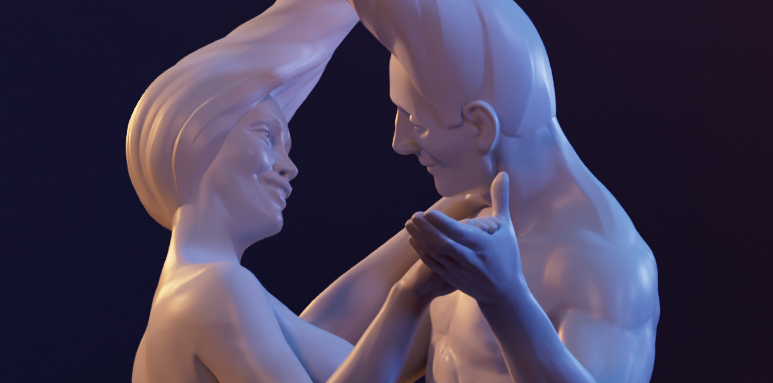
The attraction of celestial and terrestrial bodies. DNA is a smaller biological unit than the two dancing human figures. This change of scale triggered a counter-movement in the microcosm towards the macrocosm. This is how space opened up from the figures inward towards DNA and outward towards the universe. I found similarities between above and below. The above and below and the shape of DNA evoked Sándor Weöres's poem "Facing Mirrors." Below you is the earth, above you is the sky... within you is the ladder. Those who have read the poem don't need me to write the ending. 🙂 And DNA really is a ladder living within us, and the connection between generations is a ladder to infinity that transcends human life.
VI. Spirit, instinct, culture
The lyrics of DNS strongly reflect the relationship between instinct and spirit.
Yes, I looked around in this direction with my spiritual eyes and took note of what I saw. Humans are creatures characterized by instincts, the spiritual and the mental spheres. The ratio of these varies from person to person. There are those who are mainly driven by instincts and unknowingly move from one life situation to another. There are those who live more planned lives. And there are those who live pure, spiritual, sanctified lives.
As an artist, would you rather tame or unleash energies?
There are examples of each. 🙂 Each is good in its own way in the right place. 🙂 I think you need all of them to be complete. When you are present in spontaneous, instinctive painting, it is exciting to make momentary decisions on the spot. You build the picture, or the picture builds itself; in this give-and-take, interactive experience, the picture is born spontaneously.
And then there is the image that is planned in advance and then patiently, disciplinedly, methodically, and systematically executed. Where the state of planning is spontaneous. Painting is more like execution. It feels good when the picture is created step by step, but it is far from the intensity of the creative experience when it is being made. However, the end result is precise, clean, and disciplined. And you are amazed when it is finished and you look at it. Wow, I can do that too. :D? That's great. 🙂
You mentioned that you recently reread Mária Szepes's work entitled The Red Lion.
How did the content of the book resonate with this work?
I discovered a surprising number of similarities in it. I think that highly resonant, open-minded people will find many familiar ideas in the book once they understand it. A worldview with a system emerges. There are characters, life paths, life situations. After a certain age, there is compassion and understanding. A holistic worldview, a deeper understanding of the world, humanity, and the universe is not possible without a great deal of observation. And this kind of interest naturally attracted such a companion to me at one point.
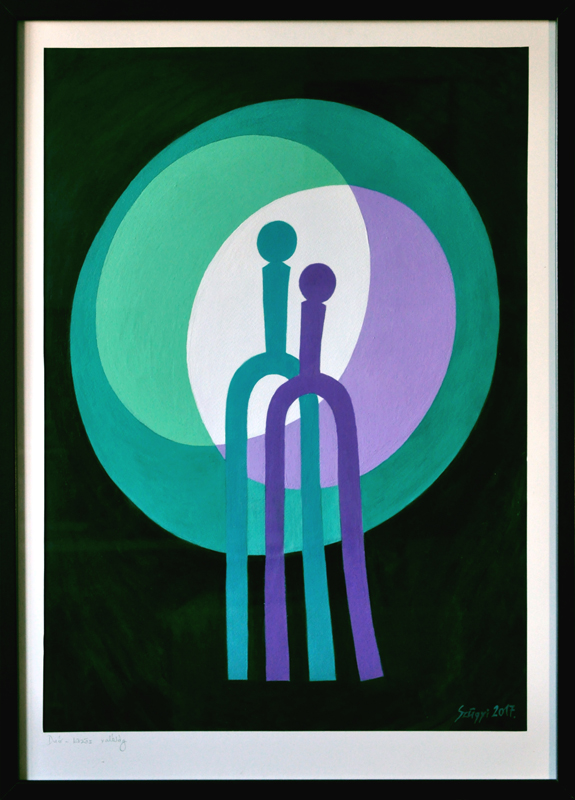
2017. Duo – shared reality
VII. Future, vision, place in contemporary art
How do you see your place in the contemporary Hungarian and international art scene?
I graduated from art school and am a highly trained artist. I know art history, I know the people I went to school with, and I follow the work of many artists. But because of my introverted nature, I rarely go to exhibitions. I've had a few solo exhibitions and group exhibitions where my work has been shown. It's time for another exhibition. I'm working on it.
If I gain the trust of galleries that sell my pictures and patrons who buy them, I can work much more and bring to the surface a much larger part of what is already in my head.
I am not really visible in the international art scene in terms of fine arts. I need to show myself more. What is better known abroad from my individual work is illustration. My IMDb profile on movies or my Mobygames profile with game credits is also international.
What can an artist who is both technologically proficient and metaphysically sensitive offer today?
I can transform this worldview into sculptures and paintings when the opportunities are right. Cutting-edge 3D technology. The boundary between the digital and physical worlds is becoming increasingly blurred. The spirit is transforming into matter with ever greater ease. With all these abilities, I can express myself in many ways. I have a few ideas in mind for 3D sculpture, as well as painting and graphic design. I have projects A, B, C... F. I have plenty of original ideas. This kind of diversity requires a flexible change of perspective. And this flexibility keeps the spirit alive.

2017. Inner voice
I have some deep, philosophical works and some lighter pieces. My favorite writers are quite profound. Béla Hamvas, Sándor Weöres, but I also like lighter things. I love Rejtő. 🙂 Who doesn't? Religion, philosophy, science, astronomy. I attended an astronomy club and come across a lot of content on these topics online. I graduated from art school and studied art history. I cook with what I have.
I have quite a few portraits and nudes. I like to talk to the model while we work because it brings out their personality. They relax and strike a pose that is characteristic of them. This makes the picture more accurate.
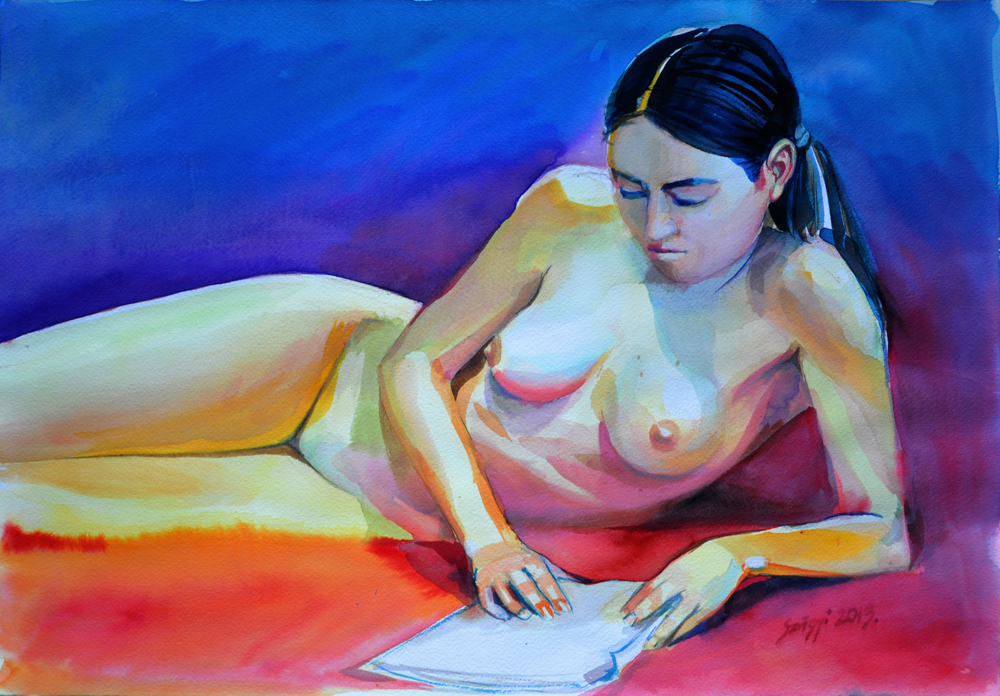
2013. Female nude reader
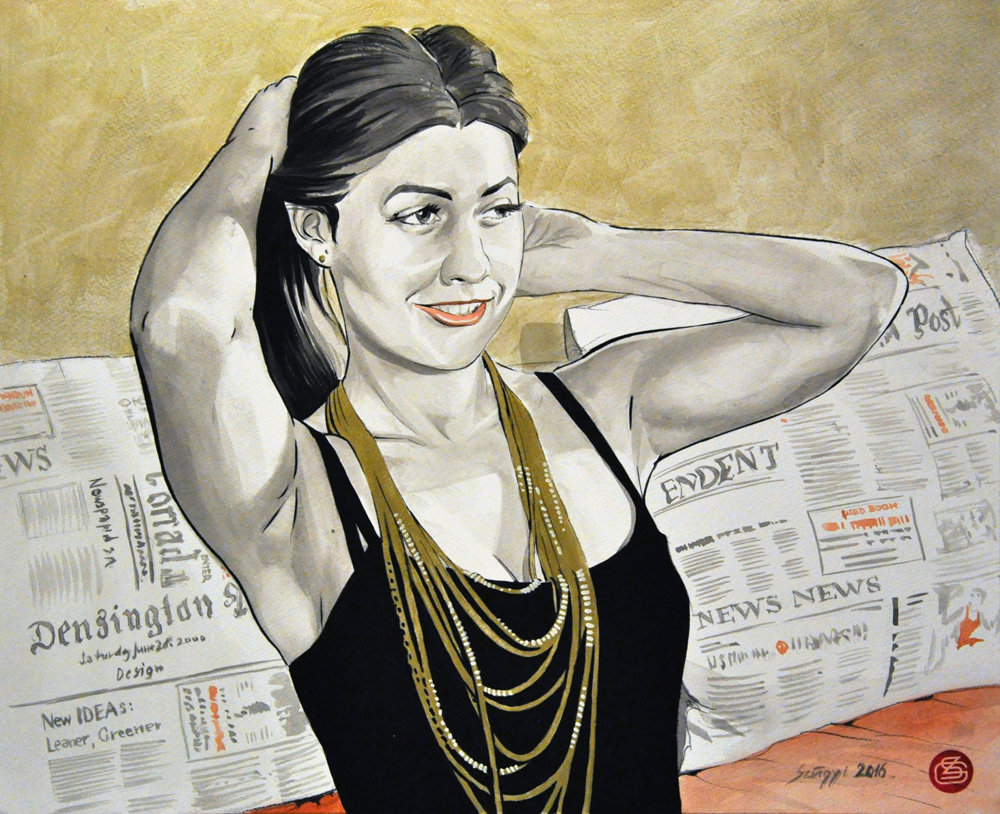
2016. Girl with a gold necklace
A more philosophical approach is the Harmonies series, which originated at the Bauhaus with Kandinsky's theory of Klang. In today's world, the colors that resonate most strongly are not those of paint but those of light, R, G, B, as on a monitor. Or on the retina. That's the direction I'm thinking in now.
The vividly colored paintings resonate well on the walls here at home, and they are pleasant to live with. 🙂 Another direction in my harmony series is the tuning fork direction. Colors have vibrations just like sounds. Sound and color are both waves. Just as atoms have vibrations. It is no coincidence that people are in a good mood when they hear good music. 🙂 And when everything complements each other and resonates together, there is harmony. This harmony is now in turmoil in the world. The relationship between humans and nature has been disrupted, and because of this disorder, the relationship between humans has also become more difficult. If we strive for harmony, we must work to achieve balance.
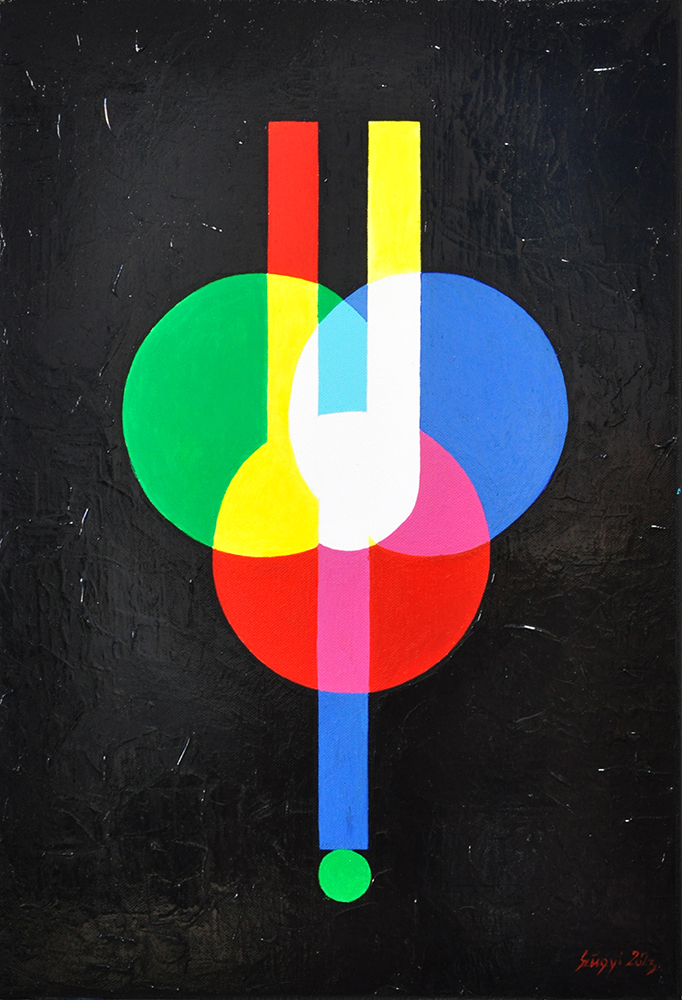
2023. RGB Tuning Fork
There are also my infinite images. When I depict self-repeating processes by bringing back what I have run out on one side of the image on the other side, creating a loopable, self-reflective, reciprocal composition. Like Atlas standing on the globe while holding it on his shoulders. That was the starting point. How can Atlas stand on Earth if the globe is on his shoulders? I bent his legs back using the trick of bringing back what runs out at the bottom, and that's how my infinite images were born. The man who precedes himself, the man who jumps over himself, the man who builds himself, and I have many other ideas that are still only at the sketch stage.
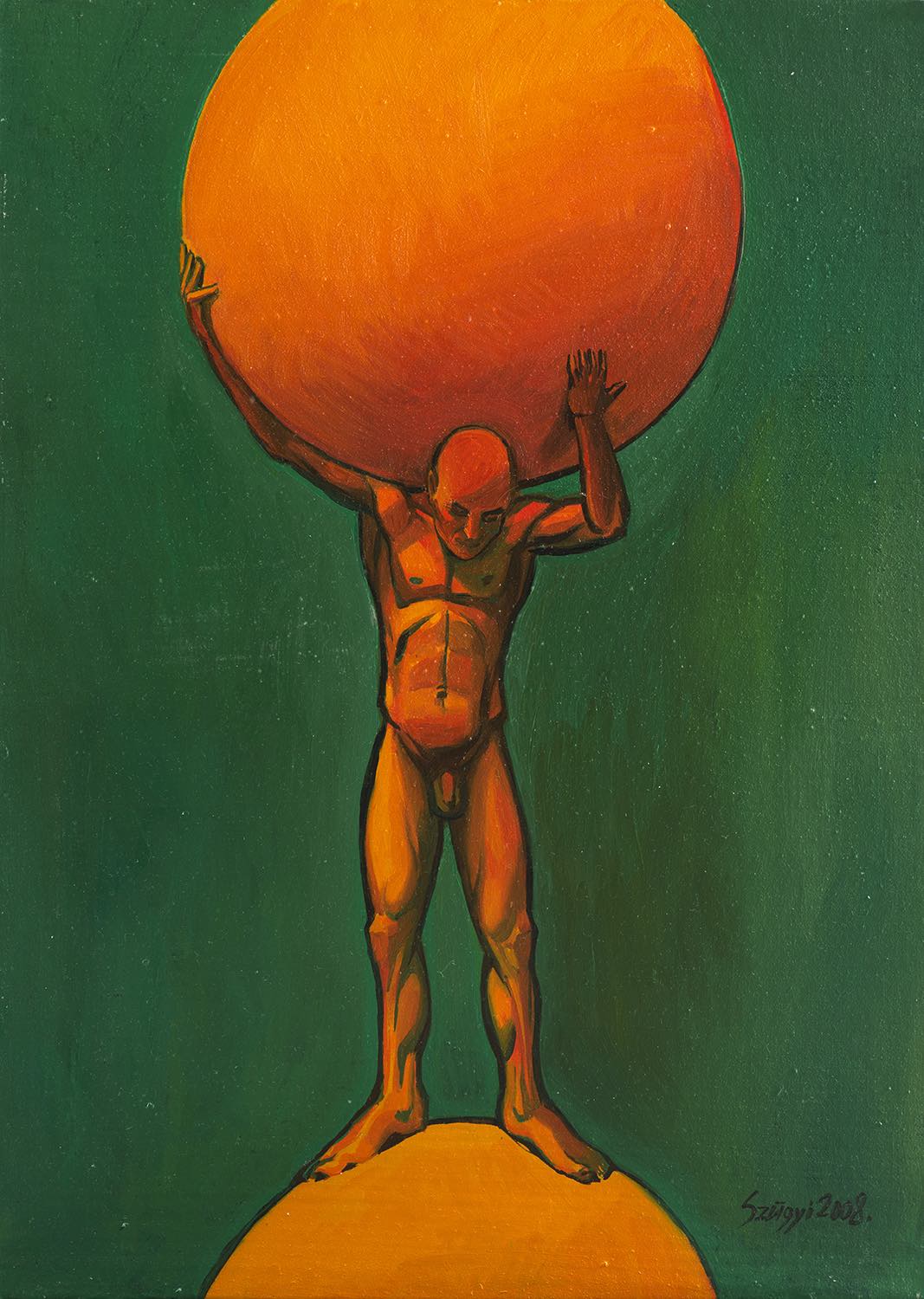
2013. Atlas
My series Spirit and Matter Intersect is a conceptual work that divides the world into two spheres, with a common area from which both the spiritual and material worlds can be seen. These images already show a unified worldview in which heaven and earth meet in the moment, in the present, in creation, in spiritual vision, and thus in consciousness.

2016. The Intersection of Spirit and Matter III.
I also learned a lot from my friends, and one of them had Péter Müller's Ji-King at home. That's how I got it. The Ji-King is a Chinese book that is thousands of years old and is often referred to as a fortune-telling book. Its name means "Book of Changes." I think it helps us understand Chinese thinking. It does not predict the future; it is not a fortune-telling book or a palmistry book. Its philosophy is that the world is not made up of static images but of processes. Those who have a knack for recognizing good processes and choosing them will do well in the future. Every process has an ascending phase, a zenith, and a decline. Those who look around before the zenith and realize where to make changes can continue to rise. That is why the book is called The Book of Change. It teaches the ability to recognize good change.
For example, if the climate changes because we are not treating it as we should, then we need to change climate change so that there is harmony. Otherwise, extreme weather will intensify, and in spring, after a brief warm spell, the fruit tree blossoms will freeze and there will be no fruit. In summer, there will be extreme heat, which will make agriculture difficult and further complicate life. This process is quite clear. And then we will have a better future if we think and act in an environmentally friendly way.
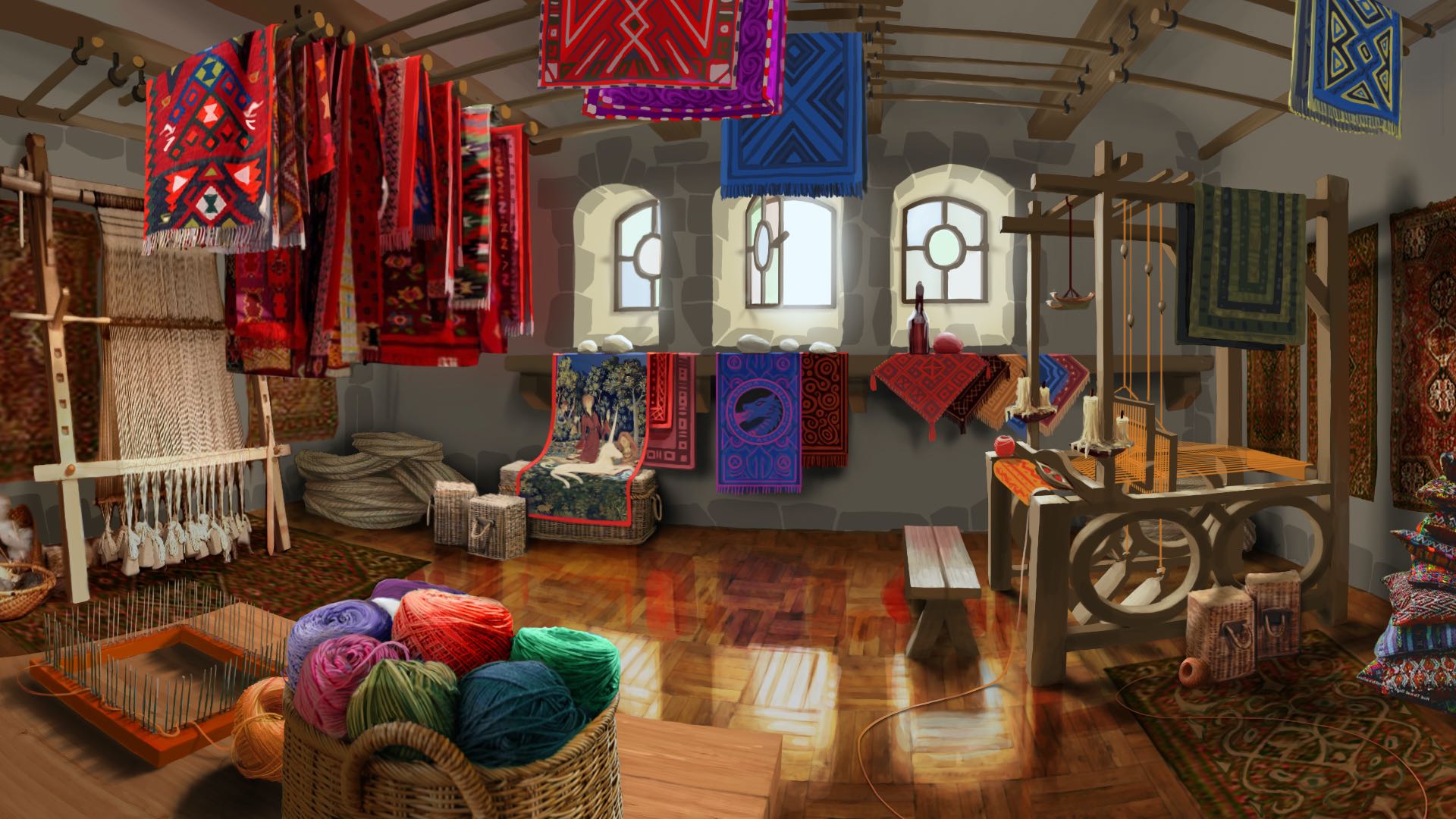
2020. Weaving workshop
What are you working on now, and where are you headed in the near future?
Ideas are delicate creatures, and must be treated with care. I have some good ideas, but timing is important, and I would rather show them when they are ready than talk about them.
Which I am happy to talk about. I have written a storybook that needs to be illustrated throughout.
The DNA dancers turn toward life. The other extreme is Danse macabre. The medieval motif is the girl with death. Dance of death. Everything is amplified when its opposite appears alongside it. Yellow by purple, light by shadow, soft by hard. Woman by man. Life by death. Sketches already exist.
What is already visible and what I am happy to talk about are my RGB images. The narrow palette and unique use of color make the pieces in the series easily recognizable. This is an abstract direction that requires disciplined execution and advance planning.
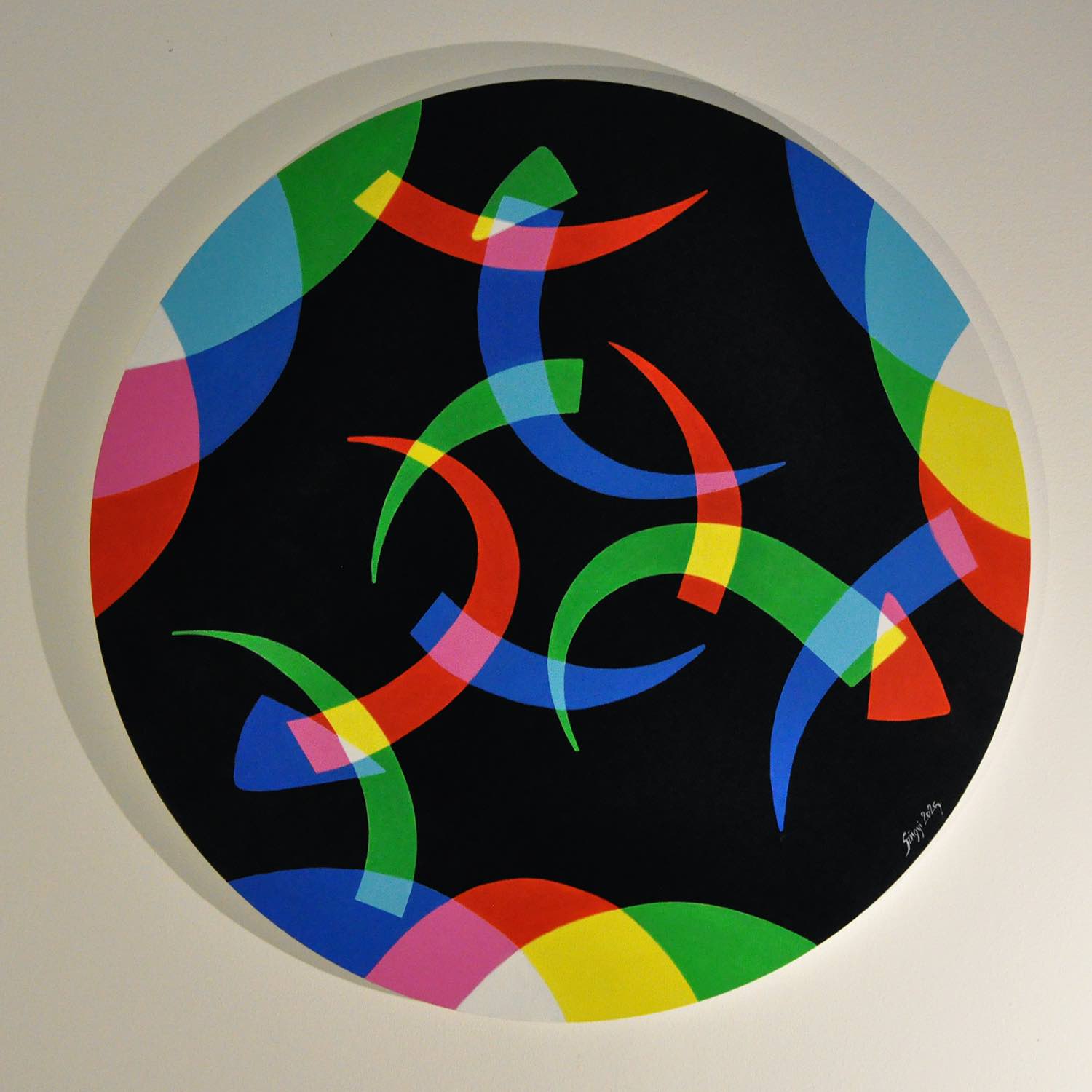
2025. Circle dance
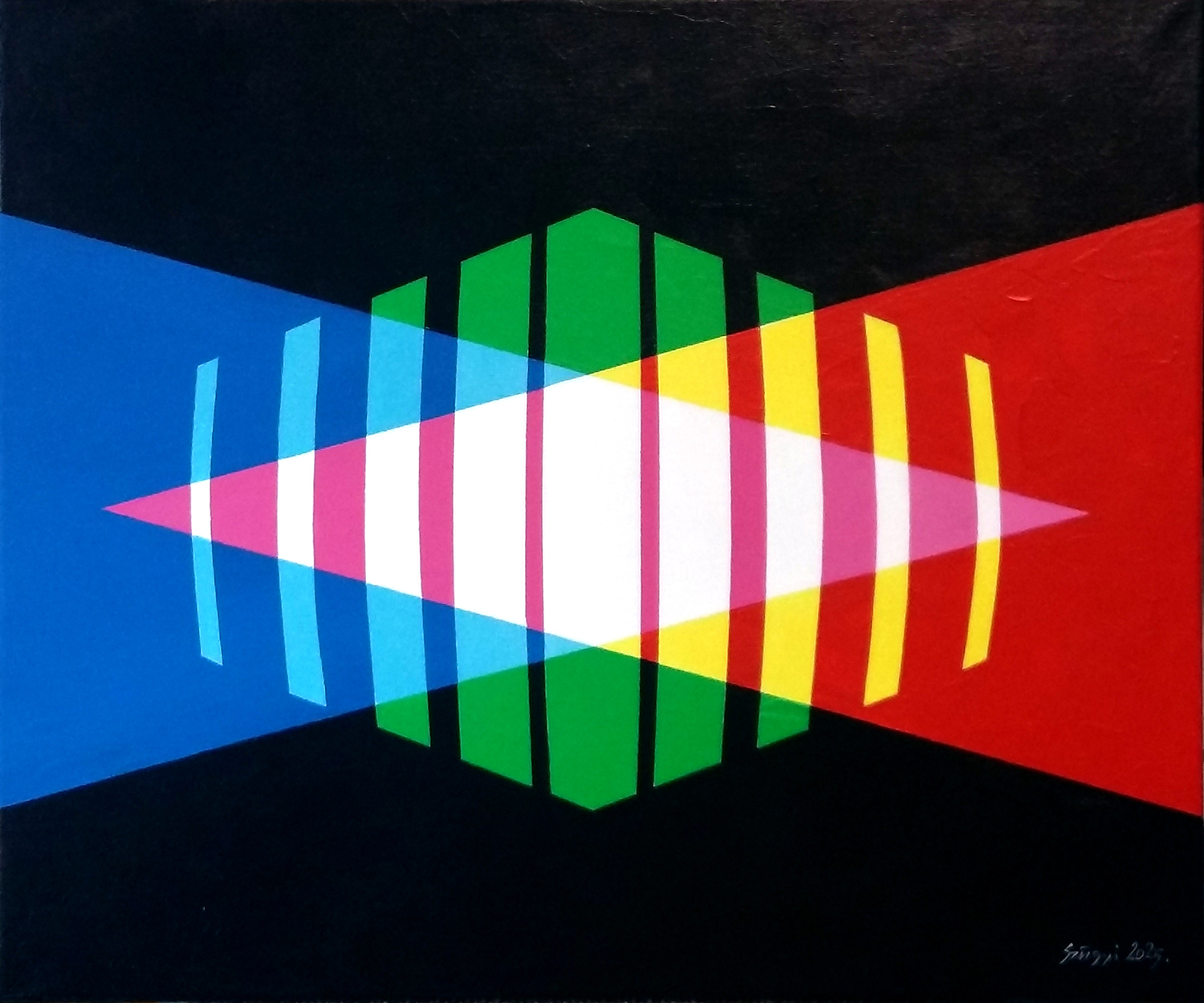
2025. Doppler effect
Next to it are the Endless Images and Harmony series. It is possible that these two themes will be expanded with new images. There are sketches for this as well.
In addition to conceptual works, I have not given up on painting for pleasure, which can be done spontaneously and with great joy. Portraits, nudes, landscapes, cityscapes. And my unique way of thinking creates something unique, a solution, from time to time. Solutions come while I'm working. Some people find a style and stick with it their whole lives. This comes as no surprise. And if they do something beautiful, sophisticated, and good, then that's totally fine.
I have a different attitude. I like to learn new things and experiment with new things from time to time. I am an experimental person. David Bowie was also a chameleon, and Picasso had his periods. There are so many things I haven't tried yet. 🙂 I would also like to make comics. I had the opportunity to work with Attila Futaki on a few pages. He was a true professional, and I gained a little more insight into the comic book process. I have been filming and illustrating for a long time; comics are a combination of these two.
When I reach the point of recognition where people begin to appreciate my diversity and what I do, then I know that they have become receptive to my art.
However, people like to label things immediately. This is not out of malice, they just want to bring order. They are also impatient and want to understand everything quickly. They try to pigeonhole things, which in my case is difficult to do.
You simply have to accept that I play several instruments and that my diversity is far from superficial. Behind it lies art history, anatomical knowledge, literature, a cosmic worldview with astronomy, science, religion, philosophy and its countless perspectives, with sufficient depth. Many professions. And I also enjoy creating in lighter genres because painting and drawing are good in every genre. I am the common point of many areas of interest.
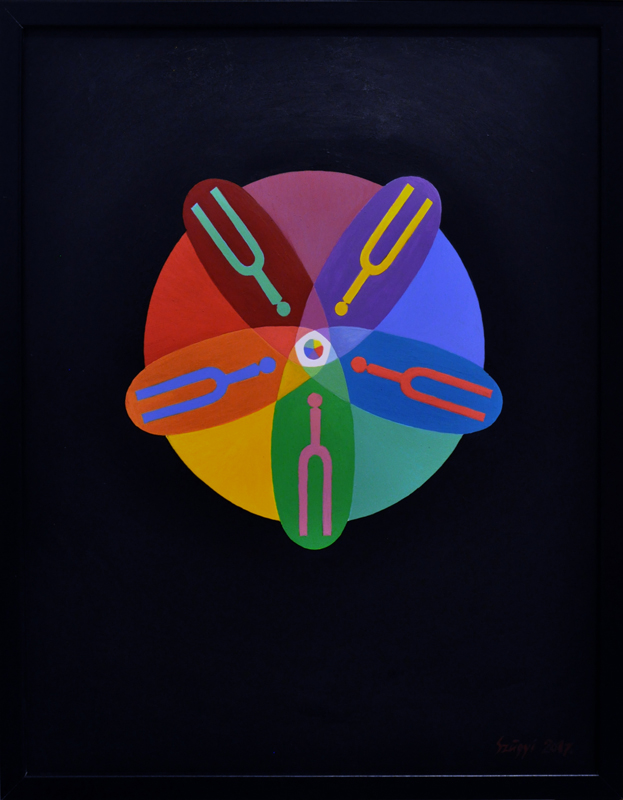
2017. Common ground
If a young artist is reading this conversation right now:
what would be your only piece of advice for him?
Learning, self-criticism, diligence. Let inspiration strike you while you work!
If you had to sum it up in one sentence:
what is Gábor Szügyi's art about?
I am a versatile creative artist,
A common feature of many genres.
All forms of creation are a joy.

Gábor Szügyi
Multifaceted artist
Further references:
Fine art works:
szugyigabor.hu/fine_art/gszugyi_Fine_Arts_eng.pdf
International customer reference:

DNS keringő / DNA waltz
I listened to many waltzes while the statue was being made. Waltzes. Everything in the world dances, revolves. This movement, this motion, is present in both the microcosm and the macrocosm. Electrons revolve around the nucleus of an atom, planets revolve around stars, moons revolve around planets, and two people who are attracted to each other revolve around each other.
🎧 Strauss's waltzes are a perfect match for it.
Liquids also swirl, forming spirals along lines of force. They are there behind the pillars of a bridge, and in the air in the vortices that form on the wings of an airplane. These patterns are also present in the movement of tiny insects circling around a lamp on a summer night, and in the unstoppable rotation of raging whirlwinds, tornadoes, and hurricanes. Circulation is a universal phenomenon. It is one of the common languages of the interaction of existing forces. The law of attraction works the same way between two people as it does between stars. Human and celestial dynamics are both part of the universe and exhibit similar patterns. As above, so below.
Look at these two figures! Their faces show joy, liberation, and mutual abandon. They drink in each other's gaze. 🙂 The man leads the dance; the woman simply places her hand on her partner's outstretched palm. They are not clinging to each other; attraction holds them together. Effortlessly, elegantly, they are together, for the joy of dancing, for the joy of company and the joy of the moment. The eternal Adam and Eve who find each other in every era, as in Madách's work. As long as the world exists. This is a motivation inherited from our ancestors. The eternal circling of man and woman around each other. Attraction, finding each other, moving together.
The figures are naked. Clothing is subject to fashion, and fashion is subject to eras. The naked human body is timeless. Timelessness. Whether in painting or sculpture. Simply human. The beauty of the human body, of anatomy.
The bodies of the spinning dancers follow the arc of DNA. Their shapes transform into DNA, and this twisted ladder leads upward into infinity. Below you is the earth, above you is the sky... This double helix leads to eternal life. Or is eternal life itself. Its components are verbs encoded in genetics. Chemical commands. Live, desire, move, rejoice, be attracted, embrace, love! Attack, defend, build, destroy, act! Hunt, catch, obtain! Enchant, embrace, melt into yourself! Create! Organize, work together for a common goal! The chemistry of behavior. Deep-seated motivations.
Learned motivations do not come from genetics, instincts, or material things, but rather restrain instincts. The spirit imposes its will on the body. It educates, cultivates, and civilizes. This is how instinct becomes dance, desire becomes orderly court etiquette, refined musical entertainment, disciplined social events, composed musical pieces, 3/4 time, waltzes, polkas, waltzes. Elegance. Be more than your instincts dictate! Learn, develop! Work! Behave! Tame your energies! Influence, create, grow! Be inspired by the spirit! Inspiration beyond the material. The metaphysical. In spiral. 🙂
The world is held together by attraction. Attraction stretches between celestial bodies and earthly bodies like an invisible link. 🙂 In the dance of the Earth and the Moon, in the tides. In cells, in developing organisms, in the primordial soup of life, in the sea, as they attract each other, connect, define roles and tasks, specialize, group together, organize, become purposeful, change, and evolve. They stand out, they blend in. Together they are more and more effective than apart. Synergy. The mystery of biology and attraction. This sculpture and the twisted ladder encode the joy of finding each other and the motivations for the continuity of life, as the two figures dance to the music of blood, circling around each other and themselves.
Looking at the sculpture, we can reflect on the fact that the universe is not a tangled mass of coincidences, but a single, enormous, eternal cycle. And we, humans, with our little dances, are part of this great movement. The waltz dreamed up by the man and woman in the sculpture is not just a movement, but a message: that all life—from the smallest cell to the largest galaxy—is an imprint of the same circular, spiraling interaction.
The spirals carved into stone in the Neolithic period may have been inspired by this universality, this archaic harmony and power, felt at the dawn of humanity when the forces of nature and humans lived in even closer contact. Perhaps when the spirals were carved, people sensed that there was magic in them. This magic is the recognition and depiction of one aspect of the forces that govern the world.
Budapest, November 23, 2025.