

In recent years, cryptocurrencies and blockchains have become increasingly popular with the promise of decentralization. However, if we look at the technical background, it quickly becomes clear that most mainstream chains are not actually fully decentralized, but heavily dependent on traditional, centralized Web 2 providers—which is more of a "Web 2.5" transition than true Web3.
In contrast, the Internet Computer (ICP) is a sovereign network that truly operates on-chain and is capable of independently ensuring the functioning of the blockchain – without the need for external cloud service providers.
Why is Web 2.5 the most common blockchain?
Mainstream cryptocurrencies—such as Ethereum, Solana, or Polygon—appear decentralized, as transactions are validated across thousands of nodes worldwide. But if we dig deeper, several critical points of centralization become apparent:
1. Running nodes
- Most nodes do not run on home servers or community infrastructure, but rather in the data centers of large companies such as Amazon Web Services (AWS), Google Cloud, or Microsoft Azure.
- For example, a significant proportion of Ethereum nodes run on AWS, giving a single company disproportionate influence over the network's infrastructure.
2. Serving DApps
-
The frontend of decentralized applications (DApps) is rarely stored on-chain. Most of them run on traditional web hosting providers, Netlify, or Cloudflare, which means centralized vulnerability.
3. Data and APIs
-
Many developers use intermediary API providers (e.g., Infura, Alchemy) to access the blockchain. While these facilitate development, they also become central gatekeepers.
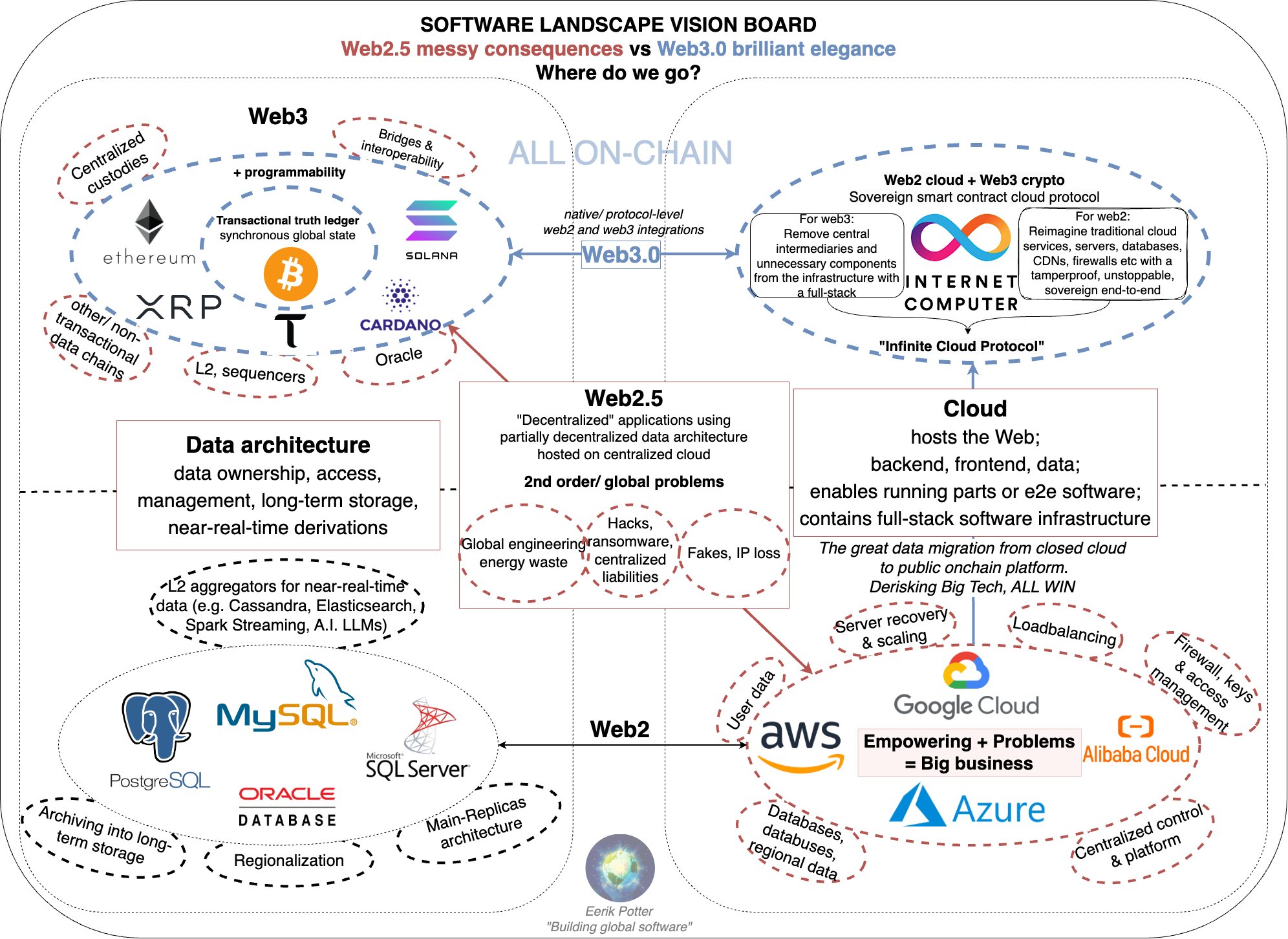
For these reasons, we can say that most blockchains are not fully decentralized, but represent a Web 2.5 world stuck in an intermediate layer.
The sovereignty of the Internet Computer (ICP)
ICP was developed by the DFINITY Foundation with the aim of decentralizing the internet itself. Not only transactions run on the chain, but also the entire application logic, data storage, and user interface.
Main technical features:
-
On-chain storage and execution
ICP's smart contracts, called "canisters," not only handle transactions, but are also capable of running entire applications. Both data and code remain on the network.
-
No need for an external cloud
ICP nodes run in dedicated data centers that connect directly to the protocol. This means there is no dependency on AWS or other centralized infrastructure.
-
On-chain web hosting
ICP allows the entire front end of websites and DApps to run on the chain. The application URL is directly linked to the blockchain, eliminating the need for separate web hosting.
-
Chain-key cryptography
This technology allows ICP to remain scalable and fast while communicating securely with other blockchains and systems.

Practical examples
1. Ethereum vs. ICP dApp
- On Ethereum: the contract logic is on-chain, but the frontend is a React application hosted on AWS, and the data points to IPFS or Arweave.
- On ICP: the contract logic, data, and frontend all run in the canister. The user communicates directly with the network; there is no intermediary service provider.
2. NFT project
- On Ethereum, images are stored on IPFS, metadata is often stored on a centralized server, and the marketplace frontend is loaded from AWS.
- On ICP, all components are located on the blockchain, including image storage and the marketplace website.
ICP tanks: decentralized storage and the evolution of cryptocurrencies
One of the most revolutionary elements of the Internet Computer is the ICP canister, which is not only a smart contract, but also an application server and storage space. A single canister can store up to 500 GB of data, which radically changes the image of blockchains. Instead of chains functioning merely as transaction logs, the ICP is capable of full-fledged data management—in a decentralized, distributed, and sovereign manner.
In practice, this means that ICP not only runs smart contracts, but is also capable of storing and serving websites, databases, files, NFTs, media content, or even data necessary for the operation of entire cryptocurrencies. With this, ICP goes beyond the semi-centralized infrastructures of Web 2.5 and truly realizes the decentralized vision of Web3.
Practical example: Migrating Ethereum to ICP
Imagine that Ethereum's blockchain infrastructure was served by ICP containers.
- All historical data on Ethereum—blocks, transactions, smart contract states—would be stored in canisters, ensuring decentralized and distributed access.
- DApps that previously ran on AWS or Google Cloud would be accessible directly from ICP canisters, eliminating dependence on Big Tech providers.
- Scaling the Ethereum network would no longer be an obstacle: ICP is capable of connecting hundreds or thousands of canisters to provide virtually unlimited storage and computing capacity.

This model can be applied not only to Ethereum, but also to other major cryptocurrencies such as Bitcoin, Solana, and Cardano. ICP is capable of integrating the entire data and transaction layer while ensuring decentralized storage, fast access, and complete sovereignty.
The next step in evolution
If mainstream blockchains migrate to ICP in the future, then:
- The compromise of Web 2.5, based on centralized servers, will cease to exist.
- Cryptocurrencies will indeed run entirely on-chain, not only at the transaction level, but also in their infrastructure.
- A truly decentralized Web3 cloud will be created, in which all chains and applications run natively.
It is a paradigm that represents the same leap for cryptocurrencies as the internet did for traditional communication. ICP is the decentralized data center of the future, where blockchains no longer operate as islands, but as a single interconnected, sovereign ecosystem.
Conclusion
The crypto world often talks about decentralization, but most chains and dApps actually rely on centralized Web 2 services—making them more like transitional "Web 2.5" solutions.
In contrast, the Internet Computer is a completely independent, on-chain sovereign network capable of realizing the true Web3 vision, where applications, data, and user experience all operate in a decentralized manner.