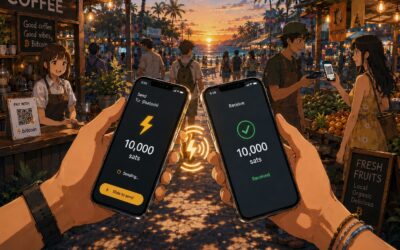


The idea for a Satoshi Calculator, developed in-house, arose from a very simple, practical question: if I’m writing about Bitcoin, the Lightning Network and peer-to-peer payments, why not make it possible to use them in practice as well? This is where Urban Művészet’s street art tours and the Bitcoin content in the magazine came together. However, in order to simply pay the price of a tour, set in forints, in satoshis, we needed a tool that could carry out the conversion in an instant based on the current Bitcoin exchange rate. And so the Satoshi Calculator was born.
Where two different worlds meet
At first glance, Urban Art seems to encompass two quite distinct areas.
One of them is street art.
The Street Art Tour of Szeged part of this initiative, those interested can explore the city’s street art works in person, learn about their history and discover the urban cultural context in which these works were created.
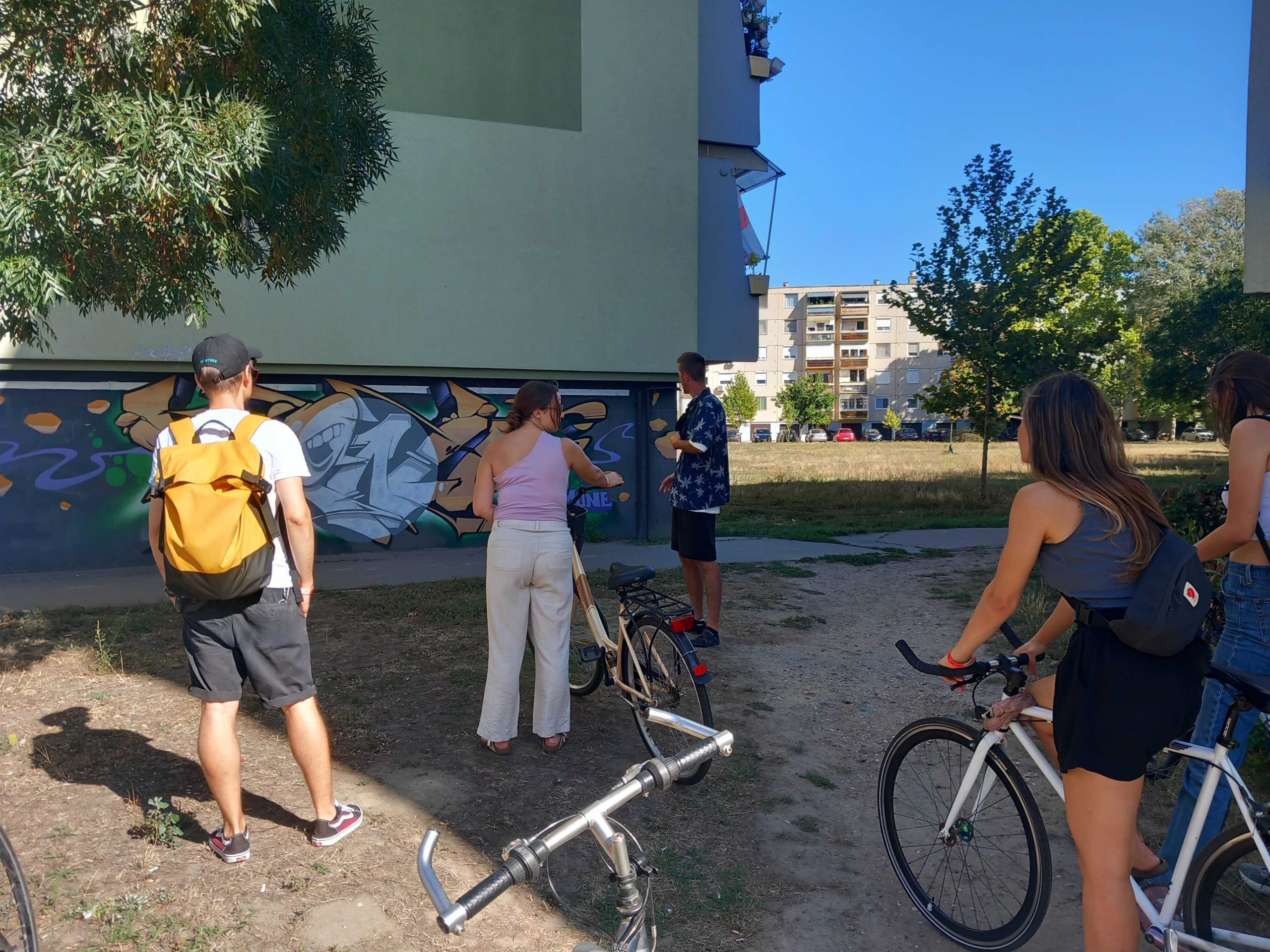
The other one is Urban Art Magazine Web3 column in which, over the past period, I have been exploring Bitcoin, decentralised technologies, the Lightning Network and the applications that make Bitcoin’s original peer-to-peer concept usable in everyday life in ever greater detail.
At one point, the question arose:
What happens if I bring these two worlds together?
If a tour guide accepts Bitcoin, why shouldn’t the fee for a street art tour be payable in satoshis via the Lightning Network?
With this, Bitcoin is no longer just the subject of an article.
It becomes a valid means of payment.
If I’m writing about it, let’s use it
Throughout this series of articles on Bitcoin, I have repeatedly returned to Satoshi Nakamoto’s original vision: an electronic cash system in which two people can exchange value directly with one another.
The Lightning Network makes this workable in practice.
With a mobile Lightning wallet, you can send satoshis to someone else in a matter of seconds.
But this is only truly significant if we don’t just talk about it, but also create situations where it can actually be put to use.
On the Szeged street art tour, therefore – where the tour guide also accepts Bitcoin payments – there may be an opportunity to pay the participation fee via the Lightning Network.
As a tour guide, I use Blink Wallet for this.
Blink is not a random choice. Formerly known as Bitcoin Beach Wallet, it grew out of the community in the town of El Zonte in El Salvador. There, too, it was born out of a very simple need: the locals needed a tool that would allow them not only to hold Bitcoin, but also to use it to pay for bread, coffee or services.
Somewhere, the same idea occurred to me, albeit on a much smaller scale.
This time, it could even be towards paying the entry fee for a street art tour.
But how much does a street art tour cost?
However, a very common problem immediately arose here.
The price of the tour is quoted in forints.
In the Lightning wallet, however, we send satoshis.
Let’s assume that the price of a service is:
5 000 HUF.
And the participant says:
“I’d like to pay in Bitcoin.”
All right.
But at that moment, how many satoshis are 5,000 forints?
The price of Bitcoin is constantly changing, so there is no fixed answer to this question.
You could look up a price chart, check the current value of one whole BTC, and then work out how many hundred millionths of that amount is equivalent to 5,000 forints.
Technically, it works.
However, it is not at all practical in a payment situation.
This is where the Satoshi Calculator his idea.
What is the Satoshi Calculator?
The Satoshi Calculator a Bitcoin exchange developed in-house and based on SAT.
Its basic function is very simple:
to show how many satoshis a given amount in forints is worth based on the current Bitcoin exchange rate.
For example, if we enter the current price of the street art tour in forints, the calculator will work out its SAT value.
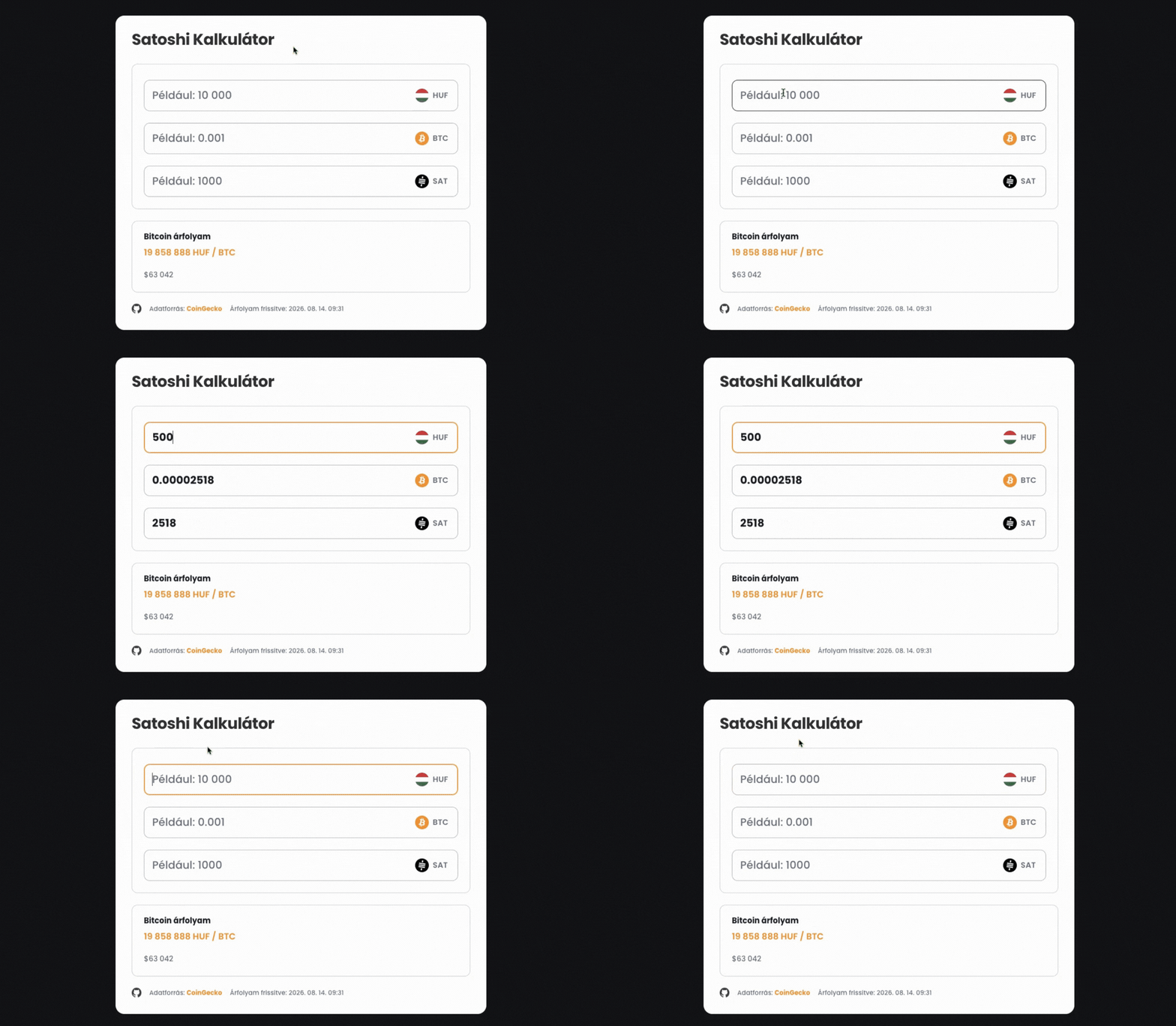
That way, neither the tour guide nor the participants need to do any mental arithmetic.
We check the current value, enter the same amount of SATs in the Lightning wallet, and then the payment can be made.
The process:
HUF → SAT → Lightning payment.
That’s it.
The technology behind the scenes is, of course, more complex than that, but the aim was precisely to ensure that the user was as unaware of it as possible.
Why ‘satoshi’, of all things?
One of the most common misconceptions about Bitcoin stems from the fact that people almost always come across the price of a whole BTC.
When a bitcoin is worth tens of millions of forints, it’s easy to think:
"Bitcoin is already too expensive for me."
Yet it is by no means necessary to own or spend a whole bitcoin.
1 BTC = 100 000 000 SAT
A satoshi is therefore not another cryptocurrency.
It is not a separate token.
It’s the same Bitcoin, just its smallest unit.
As follows:
1 metre = 100 centimetres,
or
1 kilogram = 1,000 grams,
as follows:
1 Bitcoin = 100 000 000 satoshi.
For everyday Bitcoin payments, it is therefore much more natural to think in terms of SATs.
We don’t want to see the price of a coffee, a lunch, a ticket or even a street art tour expressed as 0.0000… BTC.
It’s much simpler to say:
15 000 SAT.
The Satoshi Calculator is therefore deliberately SAT-focused.
SAT brings Bitcoin closer to everyday life
There is also an interesting psychological aspect to this.
Let’s look at the same amount in two different ways:
0,001 BTC
and
100 000 SAT
Mathematically speaking, we are talking about exactly the same value.
Humanly speaking, however, we perceive it quite differently.
100,000 SAT is easier to read, easier to remember and feels more natural to use in the context of everyday prices.
That is precisely why we are increasingly coming across amounts written in satoshis within the Lightning ecosystem.
The Satoshi Calculator aims to be a simple Hungarian tool that embodies this way of thinking.
How do you know the current exchange rate?
One of the most important factors to consider with a calculator like this is the exchange rate.
If someone is using it for a real-world payment, yesterday’s Bitcoin exchange rate – or one from a few hours ago – isn’t enough.
The calculator therefore uses external sources for Bitcoin market exchange rates.
The primary source of data is the CoinGecko.
If the primary service is unavailable for any reason, the CoinMarketCap, then the Coinranking next.
The system caches the current exchange rate for a short period, so there is no need to make a new external query for every single calculation.
The user cannot see any of this.
He just enters an amount.
Meanwhile, in the background, the system carries out the necessary conversion.
HUF, SAT and BTC – different perspectives on the same value
During the development of the calculator, it was important to ensure that it was not merely a simple ‘forint to satoshi’ calculator.
The user should also be able to see the connection.
Therefore, this value can be interpreted in several units of measurement:
HUF – Hungarian forint
SAT – satoshi
BTC – bitcoin
The current Bitcoin exchange rate is displayed in both forints and dollars, as the USD/BTC exchange rate remains one of the most commonly used benchmarks within the international Bitcoin community.
So the calculator does more than just calculate.
He teaches as well.
Anyone who uses it will, over time, instinctively begin to recognise the relationship between the forint, the satoshi and a whole Bitcoin.
It’s not a WordPress plugin, but a small standalone application
The Satoshi Calculator has turned out to be an interesting project from a technical point of view as well.
Urban Művészet runs on WordPress, and I use the Divi theme for the site’s visual layout.
However, I did not install the calculator as a WordPress plugin.
It is integrated into the website’s infrastructure as an in-house application.
The appearance of the interface is managed by HTML, CSS and JavaScript, whilst PHP handles exchange rate queries, currency conversion and some of the related server-side tasks in the background.
It is integrated into the WordPress site via a shortcode, whilst the application itself runs in a separate structure.
One of the advantages of this is that the development can be fully tailored to our own requirements.
I didn’t try to remove a hundred unnecessary features from a standard cryptocurrency converter.
I built exactly what was needed.
Not a cryptocurrency calculator
This distinction is important to me.
The aim was never to create yet another website where you can view the prices of thousands of cryptocurrencies.
The Satoshi Calculator is deliberately simple.
Bitcoin.
Satoshi.
Forint.
And the connection between them.
The focus is not on trading, nor on speculation, nor on how much Bitcoin might be worth tomorrow.
The question is much more mundane:
If something costs, say, 5,000 forints, how many satoshis do I need to send for it?
This is no longer a question of investment.
That’s a salary.
It’s when you use the calculator and the Lightning wallet together that they really come into their own
The Satoshi Calculator is not a wallet in its own right.
It does not store Bitcoin.
It does not handle private keys.
And it doesn’t send transactions.
Its role is conversion.
A Lightning wallet is still required to make an actual payment.
For the Street Art Tour of Szeged, the tour guide is the Blink Wallet use it to receive payments; a detailed guide on this has already been produced.
For those who would like to choose a different solution, I will present the options currently available in a separate summary Lightning and eCash mobile wallets too.
This is how three separate devices are connected to one another:
Street Art Tour → Satoshi Calculator → Lightning Wallet
One of them provides the service.
The other determines its current SAT value.
The third party handles the payment.
A small experiment with the real Bitcoin economy
Clearly, the fact that a street art tour accepts Bitcoin payments is not, in itself, going to change the world’s financial system.
That’s not the aim, anyway.
What I find far more interesting is that try out what I’m writing about on a small scale.
What happens if a service provider says:
Yes, can I pay by Satoshi here too?
What happens if, in addition to displaying a QR code, you also provide supporting material?
It explains what the Lightning Network is.
It showcases a practical wallet.
It helps you understand what a satoshi is.
And he’s creating a simple calculator that lets everyone see straight away how much they have to pay.
By this point, learning about Bitcoin and using it will no longer be two separate things.
One helps the other.
It wasn’t just designed for the street art tour
Although the project was inspired by a specific use case, the Satoshi Calculator will, of course, be available for anyone to use.
In case anyone is interested:
- how many SATs are there in 1,000 forints,
- How many forints is 50,000 SAT?
- how much Bitcoin a given amount of SATs is worth,
- or simply wants to get used to thinking in satoshiba,
you can use the same device.
For this very reason, the project’s next objective goes beyond the scope of Urban Art itself.
Once the calculator is complete and the feature article has been published, I would like to share the project with the Hungarian Bitcoin and cryptocurrency community as well.
According to the plan, the article and the accompanying creative materials may be made available to Hungarian cryptocurrency and Bitcoin websites so that they can showcase the tool to their own audiences.
It’s not so that the calculator remains a closed Urban Art feature.
Quite the opposite.
It was made to be used.
A Bitcoin information portal built from a calculator
During the development process, it soon became clear that it would be worthwhile to build educational content around such a tool.
That is why fundamental questions and explanations such as the following appear alongside it:
What is a satoshi?
How many satoshis are there in one Bitcoin?
Why do we use SAT for Lightning payments?
Why does the forint value of the SAT keep changing?
Do I need a whole Bitcoin?
Which wallet can I use to send or receive satoshis?
The aim is to ensure that anyone who comes across the calculator entirely by chance does not need to have any prior knowledge of Bitcoin.
It can start with a simple question:
“How much is 5,000 forints in satoshiban?”
In just a few minutes, you’ll understand what a satoshi is, what the Lightning Network is for, and which app you can use to make a real Bitcoin payment.
So, in the longer term, the calculator will result in a slightly lower Bitcoin Information Panel could also form the basis for this.
A tool born out of a real need
This is perhaps the most important part of the Satoshi Calculator’s story for me.
It wasn’t created because there was a need for yet another Bitcoin project.
It’s not just because another calculator sounds like a good idea.
But because a specific problem had arisen.
There’s a street art tour.
There is a participation fee set in forints.
There is a Lightning wallet.
Is there anyone who would like to pay in satoshi?
How many SATs should he send?
This called for a simple answer.
That’s often exactly how good technology comes about.
Not of itself.
But rather from a genuine human need.
Street art, Bitcoin and a shared idea
At first glance, it might seem a bit odd to see street art and Bitcoin mentioned in the same breath.
For me, however, there is something they all have in common.
In both cases, grassroots organisation plays a prominent role.
Independent creation.
Direct contact with people.
The idea that we don’t necessarily the case that we need permission from a central authority for everything in order to create value and share it with one another.
In one instance, this is a visual and cultural value.
In the other, financial value.
For me, therefore, the combination of the Street Art Tour and the Satoshi Calculator is not merely a new payment option.
Rather, it’s a little practical experiment.
To explore how the decentralised technologies I have written about so far can be taken into the real world of practical use.
After all, Bitcoin doesn’t become electronic cash simply because we describe it as such.
But from the moment someone says:
“Can I pay in satos?”
And the other person replies:
“Yes.” 💚₿⚡